
spurge laurel 'Margaret Mathew'
Also known as: Information to be completed
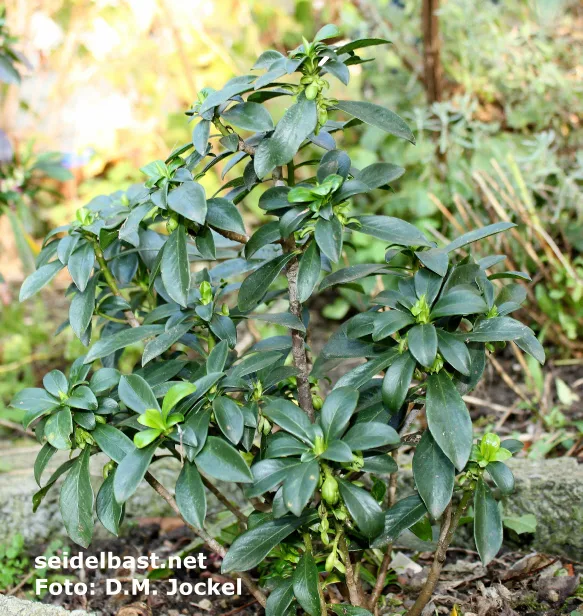
A compact evergreen shrub to 40cm, with glossy, leathery leaves. In late winter and early spring it produces clusters of fragrant, greenish-yellow flowers; these are followed by purple-black berries
Scientific classification
- Species
- spurge laurel 'Margaret Mathew' (Daphne laureola 'Margaret Mathew')
- Genus
- Daphne
- Family
- Thymelaeaceae
- Order
- Malvales
- Class
- Magnoliopsida
- Phylum
- Magnoliophyta
- TOXIC if eaten, skin irritant. Wear gloves and other protective equipment when handling]
- Toxicity
- Shrubs · Alpine Rockery
- Plant type
- 0.1-0.5 metres
- Height
- 0.1-0.5 metres
- Spread
- Evergreen
- Foliage
- Bushy
- Habit
- Spring · Summer · Autumn · Winter
- Season of interest
- Full shade · Partial shade
- Sunlight
- Information to be completed
- Ideal temperature









spurge laurel 'Margaret Mathew' pictures
Distribution of spurge laurel 'Margaret Mathew'
Distribution map
- Native
- Introduced
- Cultivated
Source:WCVP v16 · Royal Botanic Gardens, Kew · CC BY 3.0 · Boundaries:WGSRPD / TDWG
Toxicity
TOXIC if eaten, skin irritant. Wear gloves and other protective equipment when handling]
spurge laurel 'Margaret Mathew' care guide
- Moderate regular watering, avoid prolonged drought and stagnant waterlogging
- Watering
- Full shade · Partial shade
- Sunlight

Watering
Moderate regular watering, avoid prolonged drought and stagnant waterlogging
Fertilizing
 Fertilizing
Balanced perennial feed every four weeks spring through summer growth
Pruning
 Pruning
Keep pruning to a minimum: remove dead, damaged or unwanted growth; if shaping is needed, trim lightly after flowering.
Propagation
 Propagation
Propagate by semi-ripe heel cuttings
Growing
 Growing
Grow in moist but well-drained, humus rich soil in partial or deep shade. Mulch annually in spring with well-rotted organic matter to keep the roots cool. See daphne cultivation for further information
Common pests and diseases
Diseases
May be susceptible to honey fungus (rarely), phytophthora root rot, fungal leaf spot and virus diseases
Pests
May be susceptible to aphids
Explore the plant health library →




