
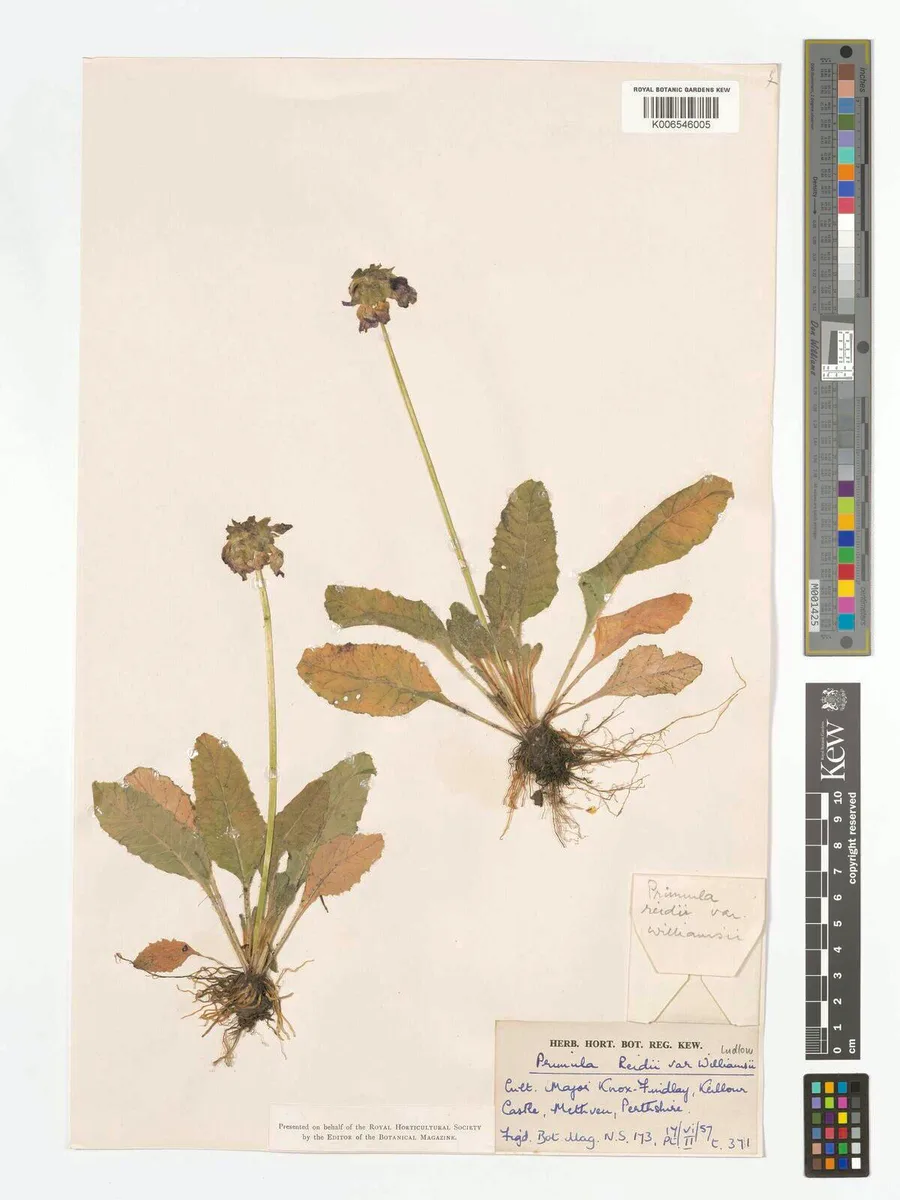
Primula reidii var. williamsii
Also known as: Information to be completed
P. reidii var. williamsii is a robust, rosette-forming, deciduous perennial with scalloped or lobed leaves up to 20cm long. In summer produces compact clusters of hanging, bell-shaped, pale blue and white, fragrant flowers on 15cm stems
Scientific classification
- Species
- Primula reidii var. williamsii (Primula reidii var. williamsii)
- Genus
- Primula
- Family
- Primulaceae
- Order
- Ericales
- Class
- Magnoliopsida
- Phylum
- Magnoliophyta
- Information to be completed
- Toxicity
- Alpine Rockery · Herbaceous Perennial
- Plant type
- 0.1-0.5 metres
- Height
- 0.1-0.5 metres
- Spread
- Deciduous
- Foliage
- Clump forming
- Habit
- Spring · Summer · Autumn
- Season of interest
- Full shade · Partial shade
- Sunlight
- Information to be completed
- Ideal temperature









Primula reidii var. williamsii pictures
Distribution of Primula reidii var. williamsii
Distribution map
- Native
- Introduced
- Cultivated
Source:WCVP v16 · Royal Botanic Gardens, Kew · CC BY 3.0 · Boundaries:WGSRPD / TDWG
Primula reidii var. williamsii care guide
- Constant cool lightly damp soil, shield roots from harsh heat
- Watering
- Full shade · Partial shade
- Sunlight

Watering
Constant cool lightly damp soil, shield roots from harsh heat
Fertilizing
 Fertilizing
Weak alpine primrose feed every three weeks spring bloom cycle
Pruning
 Pruning
Cut back after flowering
Propagation
 Propagation
Propagate by division in spring or by seed sown from autumn to spring
Growing
 Growing
Grow in deep or partial shade in peaty, gritty, moist but very well-drained soil, protected from excessive winter wet, or grow in an alpine house or cold frame in a mix of equal parts loam-based potting compost, leaf mould, peat or peat substitute and grit
Common pests and diseases
Diseases
May be affected by viruses, grey mould and primula leaf spot
Pests
May be attacked by aphids, vine weevil, leafhoppers, slugs and glasshouse red spider mite
Explore the plant health library →




