
Magnolia campbellii subsp. mollicomata
Also known as: Information to be completed
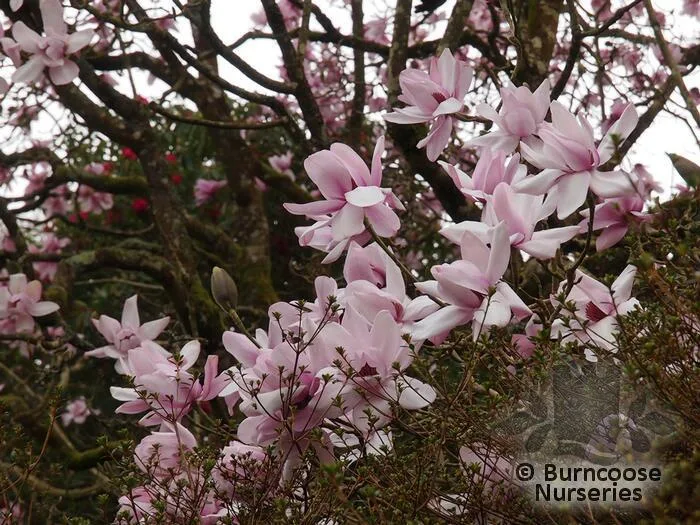
Deciduous, large tree with mid-green, ovate leaves, softly hairy on the underside, reaching over 20m in height. Flowers are abundant, initially cup-shaped then waterlily-shaped, dark pink fading to paler pink, usually flowering in early spring on bare wood, before the plant produces leaves
Scientific classification
- Species
- Magnolia campbellii subsp. mollicomata (Magnolia campbellii subsp. mollicomata)
- Genus
- Magnolia
- Family
- Magnoliaceae
- Order
- Magnoliales
- Class
- Magnoliopsida
- Phylum
- Magnoliophyta
- Information to be completed
- Toxicity
- Trees
- Plant type
- Higher than 12 metres
- Height
- wider than 8 metres
- Spread
- Deciduous
- Foliage
- Information to be completed
- Habit
- Spring · Summer · Autumn
- Season of interest
- Full sun · Partial shade
- Sunlight
- Information to be completed
- Ideal temperature









Magnolia campbellii subsp. mollicomata pictures
Distribution of Magnolia campbellii subsp. mollicomata
Distribution map
- Native
- Introduced
- Cultivated
Source:WCVP v16 · Royal Botanic Gardens, Kew · CC BY 3.0 · Boundaries:WGSRPD / TDWG
Magnolia campbellii subsp. mollicomata care guide
- Generous deep watering during dry spells, mulch to protect shallow roots
- Watering
- Full sun · Partial shade
- Sunlight

Watering
Generous deep watering during dry spells, mulch to protect shallow roots
Fertilizing
 Fertilizing
Slow-release magnolia tree fertilizer single application each early spring
Pruning
 Pruning
Magnolias usually need little pruning; remove dead, damaged or unwanted growth. For deciduous types, prune only between midsummer and early autumn. Free-standing evergreen types are pruned in spring as growth starts; wall-trained evergreen specimens are trimmed in summer, delaying cuts on flower-bud-bearing shoots until after flowering.
Propagation
 Propagation
Propagate by taking semi-ripe cuttings or softwood cuttings
Growing
 Growing
Grow in moist but well drained neutral to acid soil in full sun or light shade with shelter from cold winds. Late frost may damage the flower buds. For more information see magnolia cultivation advice
Common pests and diseases
Diseases
May be susceptible to coral spot, phytophthora, grey moulds, honey fungus, a virus or fungal leaf spot
Pests
May be susceptible to scale insects, horse chestnut scale and capsid bug
Explore the plant health library →




