
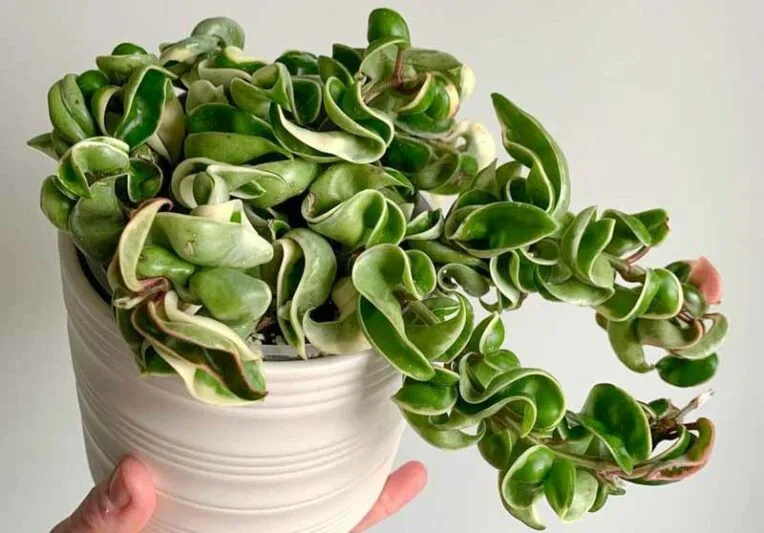
Hoya carnosa 'Compacta'
Also known as: Information to be completed
A slow-growing, semi-succulent, evergreen vine bearing opposite pairs of puckered, rigid, dark green leaves. From spring to autumn it produces domed clusters of fragrant, waxy, star-shaped flowers with red centres
Scientific classification
- Species
- Hoya carnosa 'Compacta' (Hoya carnosa 'Compacta')
- Genus
- Hoya
- Family
- Apocynaceae
- Information to be completed
- Toxicity
- Houseplants
- Plant type
- 0.5-1 metres
- Height
- 0.1-0.5 metres
- Spread
- Evergreen
- Foliage
- Trailing · Climbing
- Habit
- Spring · Summer · Autumn · Winter
- Season of interest
- Full sun · Partial shade
- Sunlight
- Information to be completed
- Ideal temperature









Hoya carnosa 'Compacta' pictures
Distribution of Hoya carnosa 'Compacta'
Distribution map
Information to be completed
Information to be completed
Culture
Information to be completed
Toxicity
Information to be completed
Quick identification of Hoya carnosa 'Compacta'
Information to be completed
Hoya carnosa 'Compacta' care guide
- Moderate regular watering, allowing brief slight drying between soakings
- Watering
- Full sun · Partial shade
- Sunlight
- Information to be completed
- Ideal temperature

Watering
Moderate regular watering, allowing brief slight drying between soakings
Fertilizing
 Fertilizing
Balanced perennial feed every four weeks from spring through summer
Pruning
 Pruning
Routine pruning is unnecessary; shorten overlong shoots to fit the available space. Prune after flowering has finished.
Propagation
 Propagation
Propagate by layering in spring or summer; root semi-ripe cuttings with bottom heat in late summer
Growing
 Growing
Grow in a fast-draining, loam-based compost with added extra organic matter. Position in bright, indirect light with shade from hot sun. In growth, water moderately and apply a balanced liquid feed monthly; keep just moist in winter. Hoyas resent repotting and can stay in the same pot for many years. See hoya cultivation
People also ask
Information to be completed
Common pests and diseases
Diseases
Generally disease-free
Pests
May be susceptible to mealybugs
Explore the plant health library →




