
heather 'Bunsall'
Also known as: Information to be completed
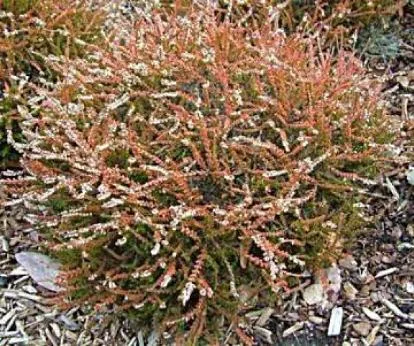
A narrow, upright, hardy evergreen shrub which can be brighter than many winter varieties, with yellow foliage which turns to shades of bronze and orange in the winter. Lavender-purple flowers are produced during August and September.
Scientific classification
- Species
- heather 'Bunsall' (Calluna vulgaris 'Bunsall')
- Genus
- Calluna
- Family
- Ericaceae
- Order
- Ericales
- Class
- Magnoliopsida
- Phylum
- Magnoliophyta
- Information to be completed
- Toxicity
- Shrubs
- Plant type
- 0.1-0.5 metres
- Height
- 0.1-0.5 metres
- Spread
- Evergreen
- Foliage
- Columnar upright · Bushy
- Habit
- Spring · Summer · Autumn · Winter
- Season of interest
- Full sun
- Sunlight
- Information to be completed
- Ideal temperature









heather 'Bunsall' pictures
Distribution of heather 'Bunsall'
Distribution map
- Native
- Introduced
- Cultivated
Source:WCVP v16 · Royal Botanic Gardens, Kew · CC BY 3.0 · Boundaries:WGSRPD / TDWG
heather 'Bunsall' care guide
- Keep acidic substrate damp, avoid severe drying of root ball completely
- Watering
- Full sun
- Sunlight

Watering
Keep acidic substrate damp, avoid severe drying of root ball completely
Fertilizing
 Fertilizing
Diluted ericaceous plant feed applied once per month in growing period
Pruning
 Pruning
Shorten flowered shoots to about 1.5–2.5 cm from the previous year's growth. If flowering is on last year's growth, prune after flowering; if on current-year growth, prune the following early to mid-spring.
Propagation
 Propagation
Propagate by semi-hardwood cuttings
Growing
 Growing
Grow in well-drained, acidic soil in full sun. See Hardy heathers for further advice
Common pests and diseases
Diseases
May be susceptible to honey fungus (rarely) and other fungal diseases
Pests
Generally pest-free
Explore the plant health library →




