
beautyberry 'Leucocarpa'
Also known as: Information to be completed
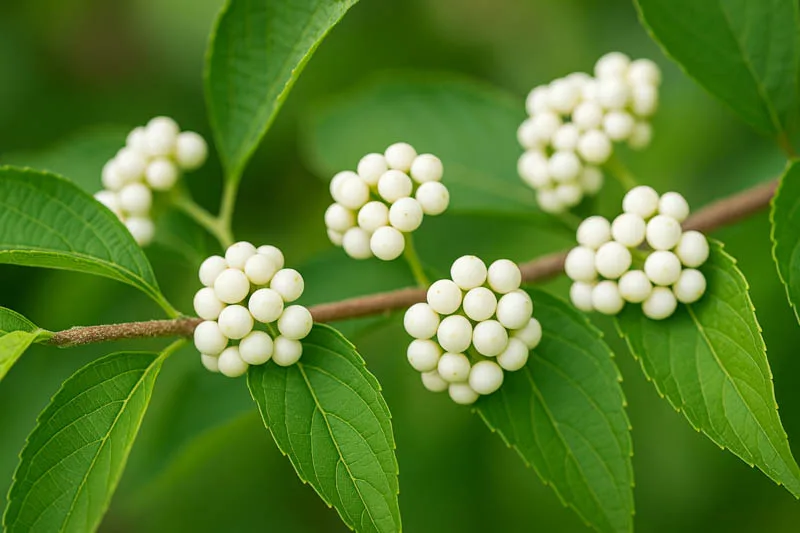
A bushy, deciduous shrub with oval to lance-shaped, tapered, pale green leaves. White flowers are borne in late summer, followed by white fruit in autumn.
Scientific classification
- Species
- beautyberry 'Leucocarpa' (Callicarpa japonica 'Leucocarpa')
- Genus
- Callicarpa
- Family
- Lamiaceae
- Order
- Lamiales
- Class
- Magnoliopsida
- Phylum
- Magnoliophyta
- Fruit are ornamental - not to be eaten. Wear gloves and other protective equipment when handling
- Toxicity
- Shrubs
- Plant type
- 1-1.5 metres
- Height
- 1-1.5 metres
- Spread
- Deciduous
- Foliage
- Bushy
- Habit
- Spring · Summer · Autumn
- Season of interest
- Full sun · Partial shade
- Sunlight
- Information to be completed
- Ideal temperature









beautyberry 'Leucocarpa' pictures
Distribution of beautyberry 'Leucocarpa'
Distribution map
- Native
- Introduced
- Cultivated
Source:WCVP v16 · Royal Botanic Gardens, Kew · CC BY 3.0 · Boundaries:WGSRPD / TDWG
Toxicity
Fruit are ornamental - not to be eaten. Wear gloves and other protective equipment when handling
beautyberry 'Leucocarpa' care guide
- Moderate regular watering, allowing brief slight drying between soakings
- Watering
- Full sun · Partial shade
- Sunlight

Watering
Moderate regular watering, allowing brief slight drying between soakings
Fertilizing
 Fertilizing
Balanced perennial feed every four weeks from spring through summer
Pruning
 Pruning
Shorten last year's flowering stems to one or two buds from the older woody framework. Remove thin, weak and dead shoots. Prune in early to mid-spring as growth resumes; avoid winter pruning that exposes new shoots to frost.
Propagation
 Propagation
Sow seed in containers in a cold frame in autumn or spring. Root softwood cuttings in spring, or semi-ripe cuttings with bottom heat in summer.
Growing
 Growing
Grow in fertile well-drained soil in sun or partial shade. Maybe cut back by severe weather, but seldom dies, usually resprouting from the base. It requires summer heat to ripen the wood.
Common pests and diseases
Diseases
May be susceptible to honey fungus (rarely)
Pests
Generally pest-free
Explore the plant health library →




