
large-leaved lime 'Aurea'
Also known as: Information to be completed
A large, fairly quick-growing dome-shaped deciduous tree with brown-grey bark and broad, toothed yellow-green foliage. Fragrant cream coloured flowers appear in June and July. A suitable variety for using as a single specimen, for an avenue of trees or for parkland planting. Pollarding highlights the golden-yellow young shoots for winter colour
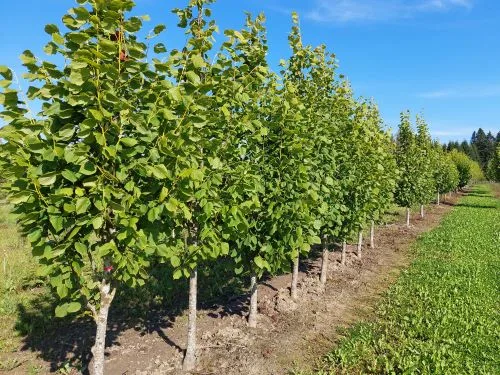
Scientific classification
- Species
- large-leaved lime 'Aurea' (Tilia platyphyllos 'Aurea')
- Genus
- Tilia
- Family
- Malvaceae
- Order
- Malvales
- Class
- Magnoliopsida
- Phylum
- Magnoliophyta
- Information to be completed
- Toxicity
- Trees
- Plant type
- 4-8 metres
- Height
- 2.5-4 metres
- Spread
- Deciduous
- Foliage
- Columnar upright
- Habit
- Spring · Summer · Autumn · Winter
- Season of interest
- Full sun · Partial shade
- Sunlight
- Information to be completed
- Ideal temperature









large-leaved lime 'Aurea' pictures
Distribution of large-leaved lime 'Aurea'
Distribution map
- Native
- Introduced
- Cultivated
Source:WCVP v16 · Royal Botanic Gardens, Kew · CC BY 3.0 · Boundaries:WGSRPD / TDWG
large-leaved lime 'Aurea' care guide
- Moderate regular watering, allowing slight drying between waterings
- Watering
- Full sun · Partial shade
- Sunlight

Watering
Moderate regular watering, allowing slight drying between waterings
Fertilizing
 Fertilizing
Balanced feed monthly during active growth season
Pruning
 Pruning
Little pruning is needed. Remove diseased, damaged, crowded or crossing shoots and unwanted growth. Timing depends on the plant: generally late winter or early spring; plants prone to bleeding and deciduous magnolias need different timing, and deciduous azaleas and lilacs are pruned after flowering.
Propagation
 Propagation
Chip budding is the most appropriate method although care must be taken with the choice of rootstock
Growing
 Growing
Easy to grow in most moist soils and will tolerate hard pruning. Is susceptible to aphid infestation and is therefore liable to sticky honeydew. Avoid exposure to cold drying winds
Common pests and diseases
Diseases
May be susceptible to sooty mould, phytophthora root disease and honey fungus
Pests
May be susceptible to aphids, horse chestnut scale, caterpillars, sawflies and gall mites
Explore the plant health library →




