
rhubarb 'Atrosanguineum'
Also known as: Information to be completed
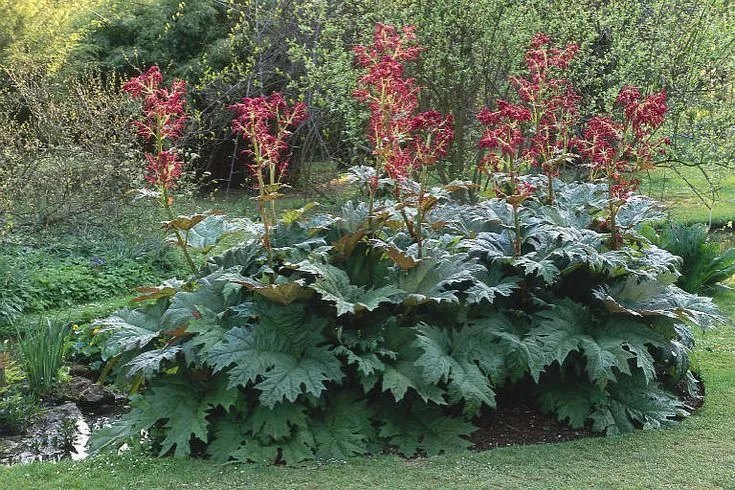
A robust herbaceous perennial with broad, palmately lobed leaves that open rich purple, fading to dark green with purplish undersides; flowers bright pink, in large erect panicles
Scientific classification
- Species
- rhubarb 'Atrosanguineum' (Rheum palmatum 'Atrosanguineum')
- Genus
- Rheum
- Family
- Polygonaceae
- Order
- Caryophyllales
- Class
- Magnoliopsida
- Phylum
- Magnoliophyta
- Harmful if eaten. Wear gloves and other protective equipment when handling LJD
- Toxicity
- Bogs · Herbaceous Perennial
- Plant type
- 1.5-2.5 metres
- Height
- 1-1.5 metres
- Spread
- Deciduous
- Foliage
- Clump forming
- Habit
- Spring · Summer · Autumn
- Season of interest
- Full sun · Partial shade
- Sunlight
- Information to be completed
- Ideal temperature









rhubarb 'Atrosanguineum' pictures
Distribution of rhubarb 'Atrosanguineum'
Distribution map
- Native
- Introduced
- Cultivated
Source:WCVP v16 · Royal Botanic Gardens, Kew · CC BY 3.0 · Boundaries:WGSRPD / TDWG
Toxicity
Harmful if eaten. Wear gloves and other protective equipment when handling LJD
rhubarb 'Atrosanguineum' care guide
- Moderate regular watering, allowing brief slight drying between soakings
- Watering
- Full sun · Partial shade
- Sunlight

Watering
Moderate regular watering, allowing brief slight drying between soakings
Fertilizing
 Fertilizing
Balanced perennial feed every four weeks from spring through summer
Pruning
 Pruning
Cut out spent flowering spikes
Propagation
 Propagation
Propagate by seed sown in autumn or by division in spring
Growing
 Growing
Grow in any reliably moist soil in full sun or partial shade. Mulch crowns in late winter
Common pests and diseases
Diseases
May be susceptible to crown rot, honey fungus and virus diseases
Pests
May be susceptible to slugs and aphids
Explore the plant health library →




