
yellow wax-bells Koreana Group
Also known as: Information to be completed
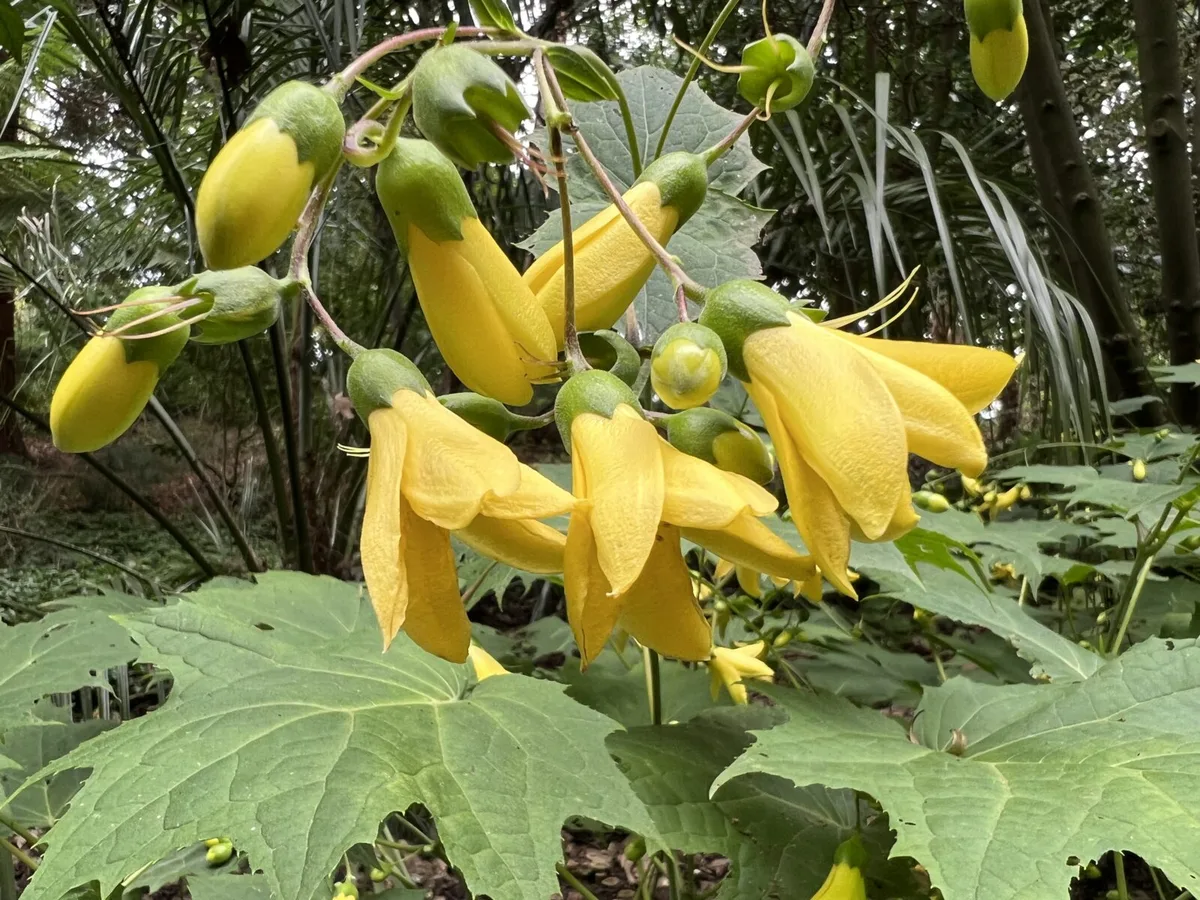
A herbaceous perennial forming a clump to 1.2m or more, with palmately lobed leaves and dark maroon stems bearing nodding, fleshy, narrowly bell-shaped creamy-yellow flowers to in open panicles. The flowers are larger than those of Kirengeshoma palmata
Scientific classification
- Species
- yellow wax-bells Koreana Group (Kirengeshoma palmata (Koreana Group))
- Genus
- Kirengeshoma
- Family
- Hydrangeaceae
- Order
- Saxifragales
- Class
- Magnoliopsida
- Phylum
- Magnoliophyta
- Information to be completed
- Toxicity
- Herbaceous Perennial
- Plant type
- 1-1.5 metres
- Height
- 0.5-1 metres
- Spread
- Deciduous
- Foliage
- Clump forming
- Habit
- Spring · Summer · Autumn
- Season of interest
- Full shade · Partial shade
- Sunlight
- Information to be completed
- Ideal temperature









yellow wax-bells Koreana Group pictures
Distribution of yellow wax-bells Koreana Group
Distribution map
- Native
- Introduced
- Cultivated
Source:WCVP v16 · Royal Botanic Gardens, Kew · CC BY 3.0 · Boundaries:WGSRPD / TDWG
yellow wax-bells Koreana Group care guide
- Moderate regular watering, allowing brief slight drying between soakings
- Watering
- Full shade · Partial shade
- Sunlight

Watering
Moderate regular watering, allowing brief slight drying between soakings
Fertilizing
 Fertilizing
Balanced perennial feed every four weeks from spring through summer
Pruning
 Pruning
Cut down the year's growth after flowering
Propagation
 Propagation
Propagate by seed in pots in a cold frame as soon as seed is ripe or in spring (germination may be erratic). Propagate by division as growth begins in spring
Growing
 Growing
Grow in moist, lime-free soil enriched with leaf mould. Prefers partial shade but tolerates denser shade; shelter from cold winds. If there is plenty of water a site in full sun may be tolerated, but is not ideal
Common pests and diseases
Diseases
Generally disease-free
Pests
May be susceptible to slugs and snails
Explore the plant health library →




