
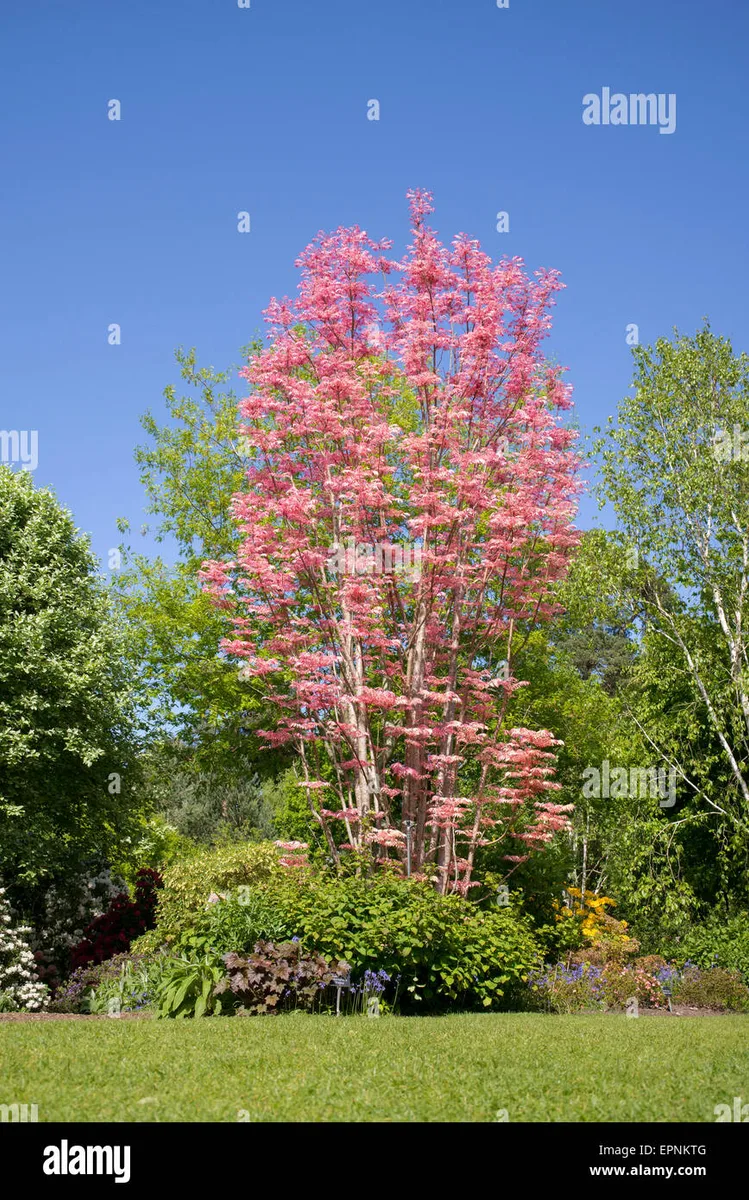
Chinese cedar 'Flamingo'
Also known as: Information to be completed
A selection of this deciduous species with bright salmon-pink spring foliage, paling to creamy-yellow then to rich green in summer. Old bark peels off in long strips. Flowers are whitish, borne in dense, drooping panicles in midsummer, fragrant. Fruits are winged capsules. All parts of the tree are aromatic, and flowers are attractive to insects
Scientific classification
- Species
- Chinese cedar 'Flamingo' (Toona sinensis 'Flamingo')
- Genus
- Toona
- Family
- Meliaceae
- Order
- Sapindales
- Class
- Magnoliopsida
- Phylum
- Magnoliophyta
- Information to be completed
- Toxicity
- Trees
- Plant type
- 8-12 metres
- Height
- 4-8 metres
- Spread
- Deciduous
- Foliage
- Bushy
- Habit
- Spring · Autumn · Summer
- Season of interest
- Full sun
- Sunlight
- Information to be completed
- Ideal temperature









Chinese cedar 'Flamingo' pictures
Distribution of Chinese cedar 'Flamingo'
Distribution map
- Native
- Introduced
- Cultivated
Source:WCVP v16 · Royal Botanic Gardens, Kew · CC BY 3.0 · Boundaries:WGSRPD / TDWG
Chinese cedar 'Flamingo' care guide
- Moderate deep watering during dry periods, free drainage preferred
- Watering
- Full sun
- Sunlight

Watering
Moderate deep watering during dry periods, free drainage preferred
Fertilizing
 Fertilizing
Balanced shrub feed once in spring
Pruning
 Pruning
Little pruning is needed. Remove diseased, damaged, crowded or crossing shoots and unwanted growth. Timing depends on the plant: generally late winter or early spring; plants prone to bleeding and deciduous magnolias need different timing, and deciduous azaleas and lilacs are pruned after flowering.
Propagation
 Propagation
Propagate by root cuttings in late winter
Growing
 Growing
Grow in fertile, well-drained soil in full sun
Common pests and diseases
Diseases
Generally trouble free
Pests
Generally pest-free
Explore the plant health library →




