
Anemone blanda 'Violet Star'
Also known as: Information to be completed
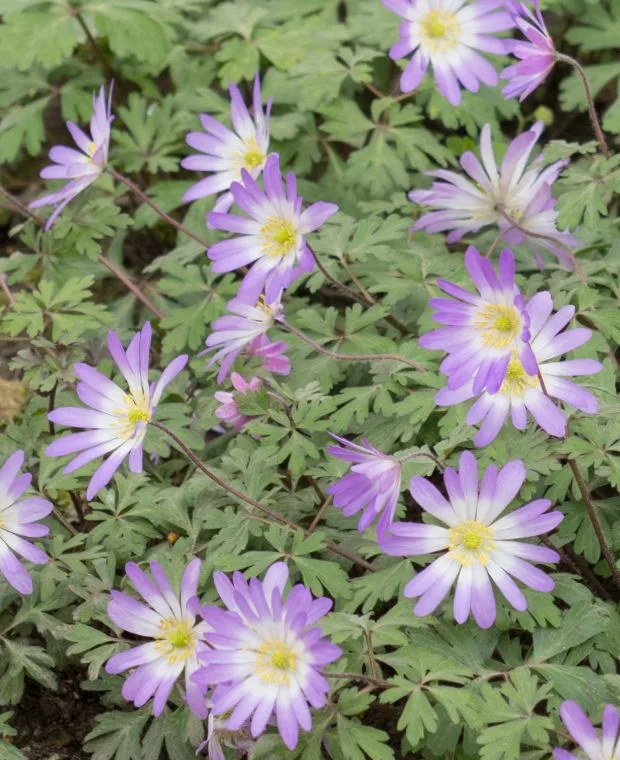
Spreading perennial to 15cm tall, quickly forming large clumps, with broadly oval, segmented, dark green stem and basal leaves with lobed leaflets. Large amethyst flowers to 4cm across have white backs to the petals, open in spring above the leaves
Scientific classification
- Species
- Anemone blanda 'Violet Star' (Anemone blanda 'Violet Star')
- Genus
- Anemone
- Family
- Ranunculaceae
- Order
- Ranunculales
- Class
- Magnoliopsida
- Phylum
- Magnoliophyta
- Information to be completed
- Toxicity
- Herbaceous Perennial
- Plant type
- 0.1-0.5 metres
- Height
- 0.1-0.5 metres
- Spread
- Deciduous
- Foliage
- Clump forming
- Habit
- Spring · Summer
- Season of interest
- Full sun · Partial shade
- Sunlight
- Information to be completed
- Ideal temperature









Anemone blanda 'Violet Star' pictures
Distribution of Anemone blanda 'Violet Star'
Distribution map
- Native
- Introduced
- Cultivated
Source:WCVP v16 · Royal Botanic Gardens, Kew · CC BY 3.0 · Boundaries:WGSRPD / TDWG
Anemone blanda 'Violet Star' care guide
- Moderate regular watering, allowing brief slight drying between soakings
- Watering
- Full sun · Partial shade
- Sunlight

Watering
Moderate regular watering, allowing brief slight drying between soakings
Fertilizing
 Fertilizing
Balanced perennial feed every four weeks from spring through summer
Pruning
 Pruning
No pruning required
Propagation
 Propagation
Propagate by division of tubers in summer when the foliage dies down and they are dormant
Growing
 Growing
Grow in moist but well-drained humus-rich soil in part shade. Drier conditions are tolerated when dormant in summer. Ideal for woodland planting or a wild garden, but has the potential to become a nuisance in favourable conditions. See anemone cultivation
Common pests and diseases
Diseases
May be susceptible to Powdery mildews
Pests
May be susceptible to leaf eelworms and damage from caterpillars and slugs
Explore the plant health library →




