



Planting and Growing common radish

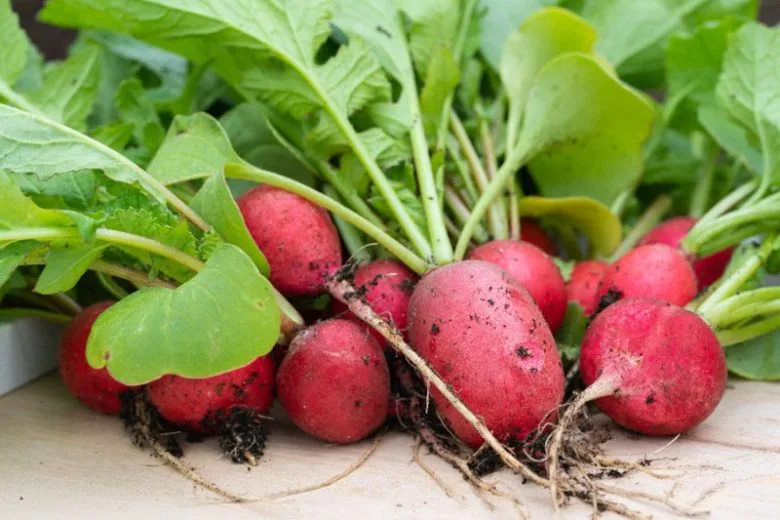
| Care difficulty | 2 / 5 |
|---|---|
| Watering schedule | Keep soil evenly moist |
| Sunlight requirements | Full sun |
| Ideal temperature | 10 – 20 °C |
| Soil type | Chalk · Clay · Loam · Sand |
| Soil pH | Acid · Alkaline · Neutral |
| Soil moisture | Moist but well drained · Well drained |
| Fertilizing | Every two weeks during growing season |
| Toxicity | Information to be completed |
How to Water common radish?
Thriving in its native fertile soils, radish has adapted to consistent moisture levels, indicative of its preference for a stable water supply. It is moderately drought-tolerant but performs best when the soil remains evenly moist without becoming waterlogged. To mimic these conditions, it's recommended to provide watering twice a week. As an annual vegetable commonly grown outdoors, radish's growth cycle is heavily influenced by regular irrigation and seasonal rainfall patterns, ensuring optimal development and yield.
Learn more →What Are the Sunlight Requirements for common radish?
Radish thrives best under full sun conditions, receiving at least six hours of direct sunlight daily, which is crucial for optimal growth and root development. Though radish tolerates partial sun, where it receives four to six hours of direct sunlight, growth may be less robust, and the roots can become elongated and less flavorful. In low light, radish may exhibit legginess as it stretches towards the light source, which can lead to weak and spindly plants. Outdoors, radish should be placed in a location that garners full sun exposure for vigorous growth and healthy root formation. Radish does not typically require indoor cultivation; however, if grown inside, a sunny windowsill that mimics outdoor conditions is suitable.
Learn more →What Is the Ideal Temperature Range for common radish?

Radish is frost hardy, with even a full hard frost only temporarily interrupting growth and bloom. Most varieties grow best in cooler weather; particularly spring varieties. Asiatic and summer varieties will tolerate warmer weather and are more likely to be stunted by colder soil conditions.
Learn more →What Soil Is Best for common radish?
Radish requires well-drained soil to avoid water-logging. A suitable mix can be prepared using equal parts garden soil, compost, and sand for enhanced drainage. If compost is unavailable, peat moss is an alternative. Ensure good aeration by regularly loosening the soil. Incorporate a balanced fertilizer, like 10-10-10, at planting and mid-season to boost growth. Regularly check soil moisture to maintain optimal conditions.
- Soil type
- Chalk · Clay · Loam · Sand
- Soil pH
- Acid · Alkaline · Neutral
What Are the Moisture Requirements for common radish?
Moist but well drained · Well drained
Learn more →How to Fertilize common radish?

For optimal growth, radish benefits from regular fertilization, using high-nitrogen formulas to meet its nutrient needs. Apply a balanced, slow-release fertilizer every 4-6 weeks during the growing season, with quantities following label instructions to avoid over-fertilization. Fertilizing radish promotes robust root development and lush foliage, crucial for the plant's rapid growth cycle. During cooler months, reduce frequency as growth slows. Ensure even distribution and water thoroughly post-application to help nutrients reach the roots. Novices should wear gloves, and experts will remember to adjust application based on soil tests for targeted nutrition.
Learn more →How to Prune common radish?

Radish is known for its crisp, edible roots. Prune to remove crowded, damaged, or yellowing leaves to enhance airflow and prevent disease. Optimal pruning time is early to later spring, aligning with its rapid growth cycle. Regular thinning ensures better root development and larger harvests. Avoid heavy pruning as it can reduce yield. Pruning also helps manage plant size and encourages healthier foliage production, ensuring robust growth and optimal harvest.
Learn more →How to Propagate common radish?

Radish, a vegetable crop valued for its edible root, is propagated predominantly through sowing. The seeds should be planted directly in well-drained, fertile soil, spaced to allow for adequate root growth. Optimal germination occurs when the soil is consistently moist. Seedlings typically emerge quickly, and thinning may be necessary to prevent overcrowding and ensure robust development. Regular watering and full sun exposure support vigorous growth.
Learn more →How to Transplant common radish?
The perfect time to transplant radish is during early to mid-spring, as it ensures a thriving growth in optimal conditions. Choose a sunny, well-drained location and provide ample space. If needed, consider transplanting under protection, such as cloches, for best results.
Learn more →How to Care for common radish in Winter?

Information to be completed
Learn more →How to Plant common radish?
Indoors-potted: Ensure radish gets ample light indoors to foster vigorous growth; rotate the pot for uniform shape and robustness. Outdoors-potted: Radish thrives in outdoor pots with room for root expansion, promoting healthy tuber formation. Outdoors-in the ground: In-ground cultivation of radish requires loose soil for optimal root development; avoid compacted areas.
Learn more →How to Repot common radish?
Needs excellent drainage in pots.
Learn more →How to Harvest common radish?

Radish grows very quickly and roots can be harvested and consumed about four weeks after sowing. For spring varieties of radish, the top portion of the bulbous root will be visible above the soil, indicating its readiness for picking. When the area of the root above the soil has a diameter of 2.5 cm, it is ready to pick. Radish can be harvested simply by pulling and, if necessary, loosening the soil surrounding the root by hand or with a garden fork.
Learn more →Common Pests & Diseases

Diseases
May be susceptible to brassica downy mildew
Pests
May be susceptible to slugs and snails, and flea beetles
Explore the plant health library →The Toxicity of common radish
Information to be completed