



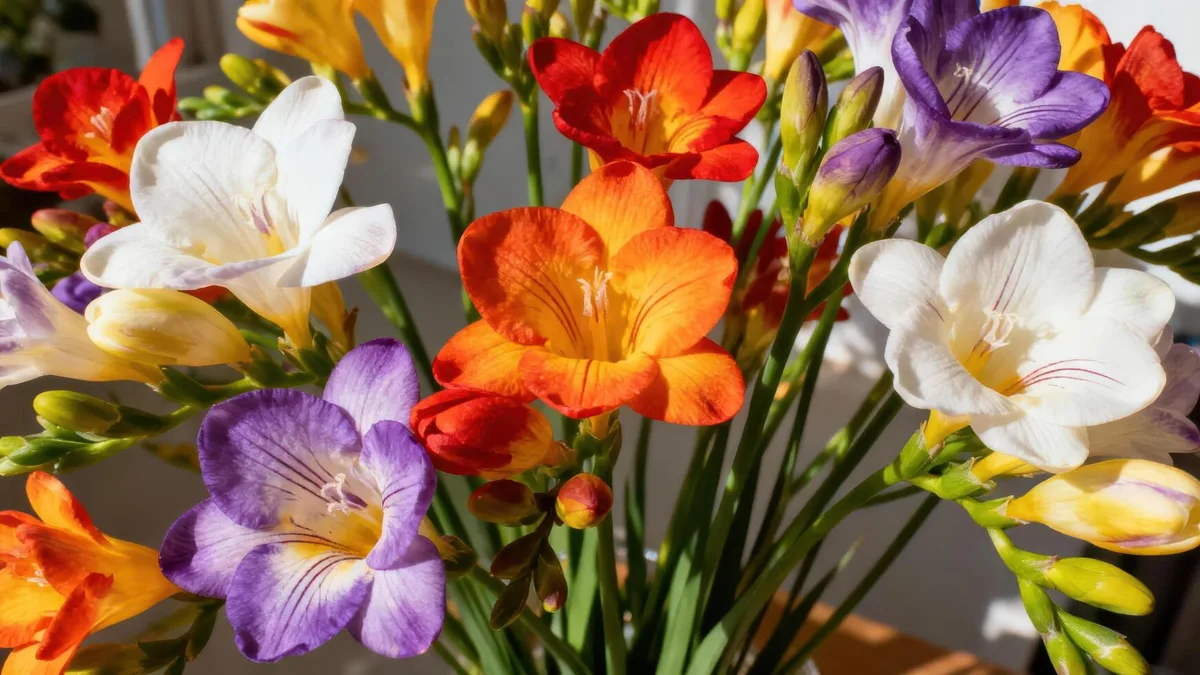
Planting and Growing freesia double mixed

| Care difficulty | 2 / 5 |
|---|---|
| Watering schedule | Moderate regular watering, allowing brief slight drying between soakings |
| Sunlight requirements | Full sun |
| Ideal temperature | Information to be completed |
| Soil type | Chalk · Clay · Loam · Sand |
| Soil pH | Acid · Alkaline · Neutral |
| Soil moisture | Moist but well drained |
| Fertilizing | Balanced perennial feed every four weeks from spring through summer |
| Toxicity | Information to be completed |
How to Water freesia double mixed?
Moderate regular watering, allowing brief slight drying between soakings
Learn more →What Are the Sunlight Requirements for freesia double mixed?
Full sun
Learn more →What Soil Is Best for freesia double mixed?
- Soil type
- Chalk · Clay · Loam · Sand
- Soil pH
- Acid · Alkaline · Neutral
What Are the Moisture Requirements for freesia double mixed?
Moist but well drained
Learn more →How to Fertilize freesia double mixed?

Balanced perennial feed every four weeks from spring through summer
Learn more →How to Prune freesia double mixed?

No pruning required
Learn more →How to Propagate freesia double mixed?

Propagate by separating corm offsets, or by seed. Young plants take a few seasons to reach flowering size. See freesia cultivation
Learn more →How to Plant freesia double mixed?
Freesias naturally flower in early spring, but need frost-free conditions. Plant corms in autumn, outdoors in very mild areas, or in containers in a frost-free greenhouse. Specially prepared corms can be planted outdoors in mid-spring to flower in late summer, but will only do this for the first year. See freesia cultivation
Learn more →Common Pests & Diseases

Diseases
May be susceptible to dry rot and Fusarium wilt
Pests
May be susceptible to glasshouse red spider mite and aphids
Explore the plant health library →