
freesia double mixed
Also known as: Information to be completed
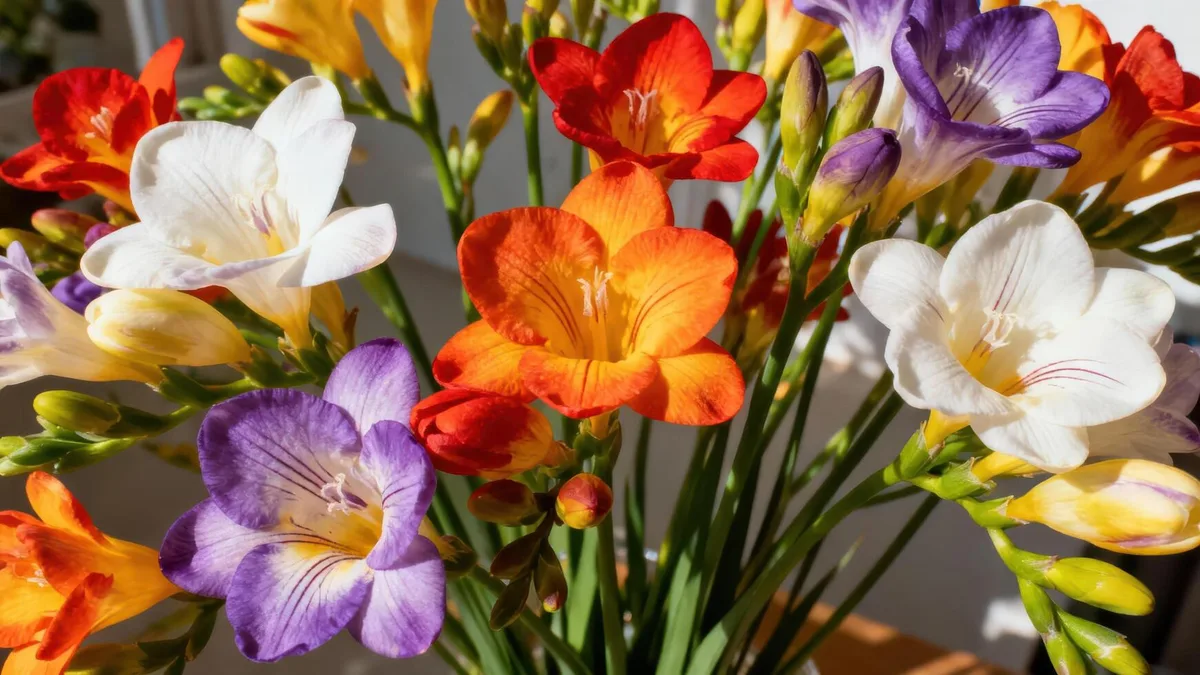
A colour mix of tender flowering perennials which grow from bulb-like structures known as corms. In late winter, spring or summer (depending on time of planting), funnel-shaped, double, scented flowers in mauve, orange, white, yellow and cerise bloom sequentially on thin arching stems above sword-shaped, mid-green leaves. Height around 45cm (18in).
Scientific classification
- Species
- freesia double mixed (Freesia [Double Mixed])
- Genus
- Freesia
- Family
- Iridaceae
- Information to be completed
- Toxicity
- Bulbs
- Plant type
- 0.1-0.5 metres
- Height
- 0.1-0.5 metres
- Spread
- Deciduous
- Foliage
- Clump forming
- Habit
- Spring · Summer · Winter
- Season of interest
- Full sun
- Sunlight
- Information to be completed
- Ideal temperature









freesia double mixed pictures
Distribution of freesia double mixed
Distribution map
Information to be completed
Information to be completed
Culture
Information to be completed
Toxicity
Information to be completed
Quick identification of freesia double mixed
Information to be completed
freesia double mixed care guide
- Moderate regular watering, allowing brief slight drying between soakings
- Watering
- Full sun
- Sunlight
- Information to be completed
- Ideal temperature

Watering
Moderate regular watering, allowing brief slight drying between soakings
Fertilizing
 Fertilizing
Balanced perennial feed every four weeks from spring through summer
Pruning
 Pruning
No pruning required
Propagation
 Propagation
Propagate by separating corm offsets, or by seed. Young plants take a few seasons to reach flowering size. See freesia cultivation
Growing
 Growing
Freesias naturally flower in early spring, but need frost-free conditions. Plant corms in autumn, outdoors in very mild areas, or in containers in a frost-free greenhouse. Specially prepared corms can be planted outdoors in mid-spring to flower in late summer, but will only do this for the first year. See freesia cultivation
People also ask
Information to be completed
Common pests and diseases
Diseases
May be susceptible to dry rot and Fusarium wilt
Pests
May be susceptible to glasshouse red spider mite and aphids
Explore the plant health library →




