



Planting and Growing chalk agave

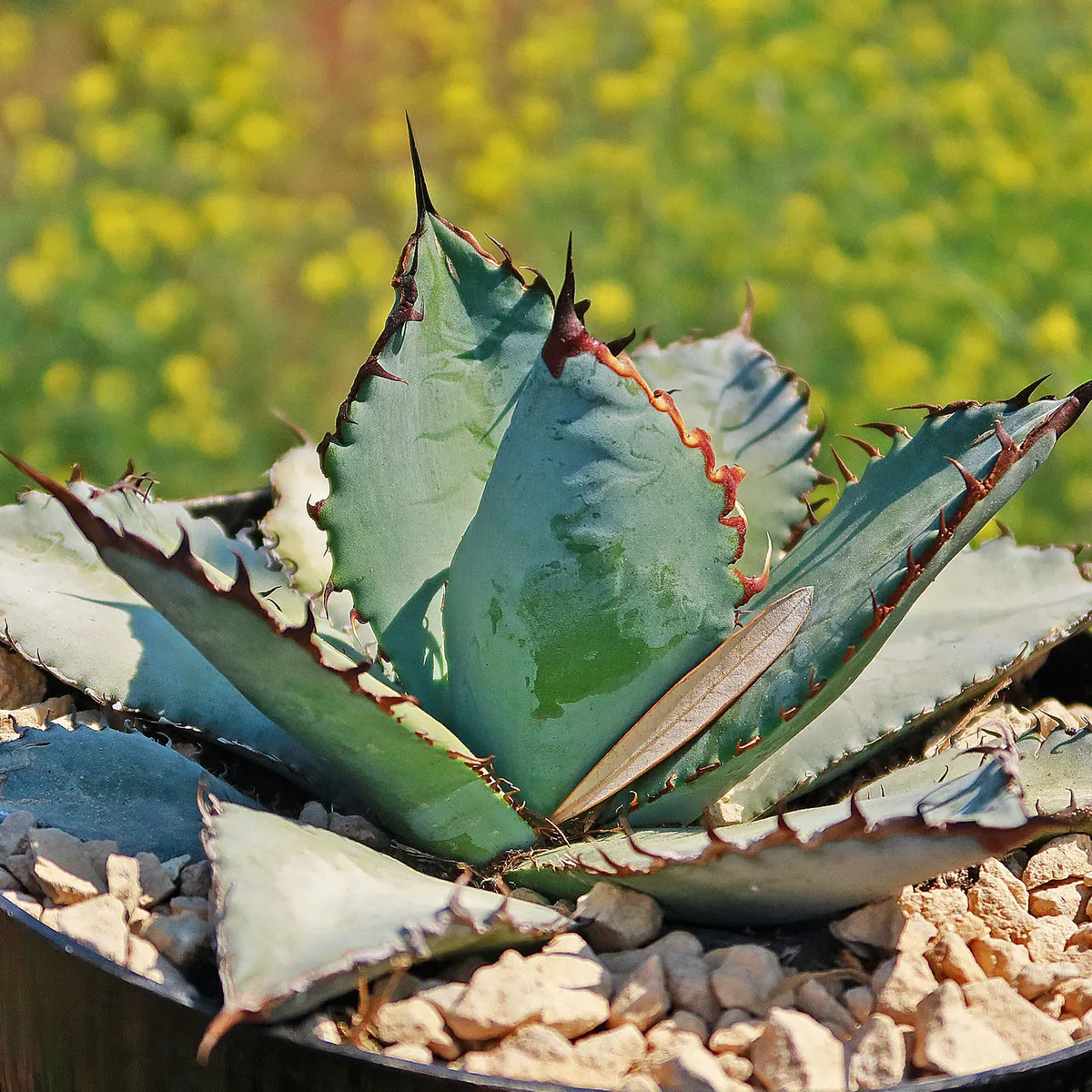
| Care difficulty | 3 / 5 |
|---|---|
| Watering schedule | Moderate regular watering, allowing brief slight drying between soakings |
| Sunlight requirements | Full sun |
| Ideal temperature | 18 – 28 °C |
| Soil type | Loam · Sand |
| Soil pH | Acid · Alkaline · Neutral |
| Soil moisture | Well drained |
| Fertilizing | Balanced perennial feed every four weeks from spring through summer |
| Toxicity | Skin irritant. Wear gloves and other protective equipment when handling |
How to Water chalk agave?
Rancho tambor agave is a plant adapted to arid environments, exhibiting high drought tolerance. Its water requirements are relatively balanced, neither too much nor too little. The watering frequency for this species is once every three weeks. As an evergreen plant, rancho tambor agave retains its leaves throughout the year, thus reducing water loss through transpiration. This characteristic makes it suitable for growing in containers where moisture can be easily controlled.
Learn more →What Are the Sunlight Requirements for chalk agave?
Rancho tambor agave thrives best under full sun exposure, where it can bask in uninterrupted light for most of the day. This optimal light condition supports its growth and enhances its health, causing the plant to produce stronger, more succulent leaves that are characteristic of its robust nature. While rancho tambor agave is adaptable enough to withstand partial sun, lesser light may slow its growth and diminish the vibrancy of its foliage. Typically cultivated outdoors, it is advisable to plant rancho tambor agave in garden spots or landscapes where direct sunlight is abundant, ensuring it receives the necessary intensity and duration of light for flourishing growth.
Learn more →What Is the Ideal Temperature Range for chalk agave?

Rancho tambor agave is notable for its impressive temperature tolerance, enduring cold as low as 0℃ (32℉) and heat up to 38℃ (100℉). This robustness means rancho tambor agave can thrive in various climates, but during extreme cold or heat, protective measures like mulching or shading may be necessary. Symptoms of stress in cold temperatures include leaf discoloration and softening, while overheating may cause leaf curling or browning. Countermeasures include relocating the plant to a sheltered spot during cold snaps and increasing hydration and ventilation in hot weather. This adaptability makes rancho tambor agave suitable for diverse environments, although monitoring for extreme conditions is crucial.
Learn more →What Soil Is Best for chalk agave?
Rancho tambor agave should be planted in soil that is loose, fertile, has good drainage, and is mixed with mold and coarse sand. This fulfills the plant's requirements for looseness, permeability of water and air, supply of nutrients, etc. The matrix and ratio for reference are 2/5 Leaf mold + 3/10 pine needle soil + 1/5 coarse sand + 1/10 bone meal. The soil proportions can also be adapted to the environment where the plant is planted. If the environment is rainy and humid, the proportion of coarse sand can be increased to endure good drainage and avoid root rot caused by the accumulation of water at the roots. If the environment is dry with little rain, the proportion of leaf mold can be increased to maintain moisture in the soil so that the roots will not wither due to dryness.
- Soil type
- Loam · Sand
- Soil pH
- Acid · Alkaline · Neutral
What Are the Moisture Requirements for chalk agave?
Well drained
Learn more →How to Fertilize chalk agave?

For rancho tambor agave, a balanced succulent fertilizer promotes healthy growth and resilience. During active growth in spring and summer, fertilize rancho tambor agave monthly, diluting to half the recommended strength to avoid overfertilization. Refrain from feeding in fall and winter when rancho tambor agave's growth slows. Always water the soil before applying fertilizer to protect rancho tambor agave's roots. Novice gardeners should use caution to prevent fertilizer burn. This targeted nutrient boost is especially crucial for container-grown rancho tambor agave, which have limited soil resources.
Learn more →How to Prune chalk agave?

As new leaves grow, the lower leaves will gradually yellow and finally dry. Removing the old leaves promptly will keep rancho tambor agave looking good. Leaves that are infected with pests and diseases should be trimmed to prevent infecting healthy leaves.
Learn more →How to Propagate chalk agave?

Rancho tambor agave, belonging to the Agavaceae family, is a robust and striking species favored for its architectural foliage and resilience. Propagation of rancho tambor agave is most viable through the method of division. This process involves the careful separation of offsets or 'pups' that grow at the base of the parent plant. Gardeners should gently extract these offsets with roots intact and allow them to dry for several days before planting in well-draining soil, thereby ensuring successful establishment and growth of new individuals without compromising the health of the mother plant.
Learn more →How to Transplant chalk agave?
For rancho tambor agave, the most opportune time for relocation is the onset of warm weather, during the late spring thaw into the balmy start of summer. Choose a sunny, well-draining spot to encourage robust growth. If needed, enriching the soil with some local compost can give rancho tambor agave a healthy start in its new home. Remember, tender care translates to a thriving plant.
Learn more →How to Plant chalk agave?
Rancho tambor agave has a high germination rate through sowing, which is usually carried out in spring. The optimum temperature for seed germination is no less than 15 ℃ at night and around 30 ℃ during the day. If the temperature falls below 10 ℃ at night and 20 ℃ during the day, the rate of seed germination will be greatly reduced. After sowing, you must cover the surface of the pot with plastic wrap to preserve the warmth and moisture within. After 7 - 10 days, seedlings will emerge. Rancho tambor agave grows slowly, so there is no need for frequent repotting. Large particles such as ceramsite with a diameter of about 1 cm can be laid at the bottom of the pot to prevent water accumulation and root rot. Plant in pots with good permeability, such as earthenware. The size of the pot should be 2-3 times the size of the plant to ensure that there is enough space and soil fertility for rancho tambor agave to grow.
Learn more →How to Repot chalk agave?
Rancho tambor agave flourishes as a slow-growing succulent, reaching a substantial size without climbing or spreading. For optimal health, repot every 2 years in spring, before the active growth phase. A slightly larger pot with drainage holes will accommodate its robust roots. Post-repotting, provide bright light and refrain from watering for a week to prevent root rot and encourage strong growth.
Learn more →Common Pests & Diseases

Diseases
Generally trouble free except in wet or poorly drained soil when it could be susceptible to root rot
Pests
May be susceptible to scale insects
Explore the plant health library →Troubleshooting
Soft Basal Rot vs. Wrinkled Dehydrated Leaves or Stems
chalk agave (Agave titanota) stores water in fleshy tissues and relies on fast-draining mineral soil; waterlogged roots in cool or heavy compost quickly cause basal rot.
| What you notice | Possible explanation | What to check next |
|---|---|---|
| Base of stem or lower leaves turns dark brown/black, soft, and translucent while soil stays damp | Root or stem rot from overwatering, poor drainage, or watering during cool dormancy | Check pot drainage holes, inspect lower soil wetness, and test stem firmness gently |
| Fleshy leaves or stems look wrinkled, deflated, or limp while gritty soil is bone dry during active growth | Underwatering as the plant draws on stored tissue moisture | Check deep soil dryness and confirm daytime temperatures are in the active growth range |
- Pot in a sharply drained cactus/succulent compost (amended with coarse sand, grit, pumice, or perlite) in a container with open drainage holes.
- Follow seasonal moisture cues: Moderate regular watering, allowing brief slight drying between soakings.
- If rot develops at the base, cut away healthy upper stems or offsets with a sterilized blade, let cut ends dry and callous for several days, and root in fresh gritty mix.
Stop watering immediately if soft black rot spreads from the base, and discard rotted tissues and wet old soil.
Etiolated Green Growth or Mealybugs and Scale
Insufficient direct sunlight stretches new growth and dulls natural stress coloration in chalk agave (Agave titanota), while mealybugs and scale often hide in leaf axils or around roots.
| What you notice | Possible explanation | What to check next |
|---|---|---|
| New growth stretches pale green with wide internodes instead of staying compact and richly colored | Insufficient bright direct sunlight | Evaluate daily hours of direct sun exposure at the current site |
| White cottony tufts, sticky honeydew, or hard brown bumps along stems and leaf bases | Sap-sucking pests (May be susceptible to scale insects) | Inspect stem junctions, leaf undersides, and the soil line closely |
- Acclimate gradually to full sun so new growth develops compact form and natural coloration without sudden sunburn.
- Isolate infested plants and dab visible mealybugs or scale with rubbing alcohol on a cotton swab, or apply insecticidal soap per label directions.
- Protect frost-tender plants indoors or under cover before freezing weather arrives.
Already stretched stems will not shrink back, though compact healthy growth will resume once bright light is restored.
The Toxicity of chalk agave
Skin irritant. Wear gloves and other protective equipment when handling