



Planting and Growing dark purple houseleek tree

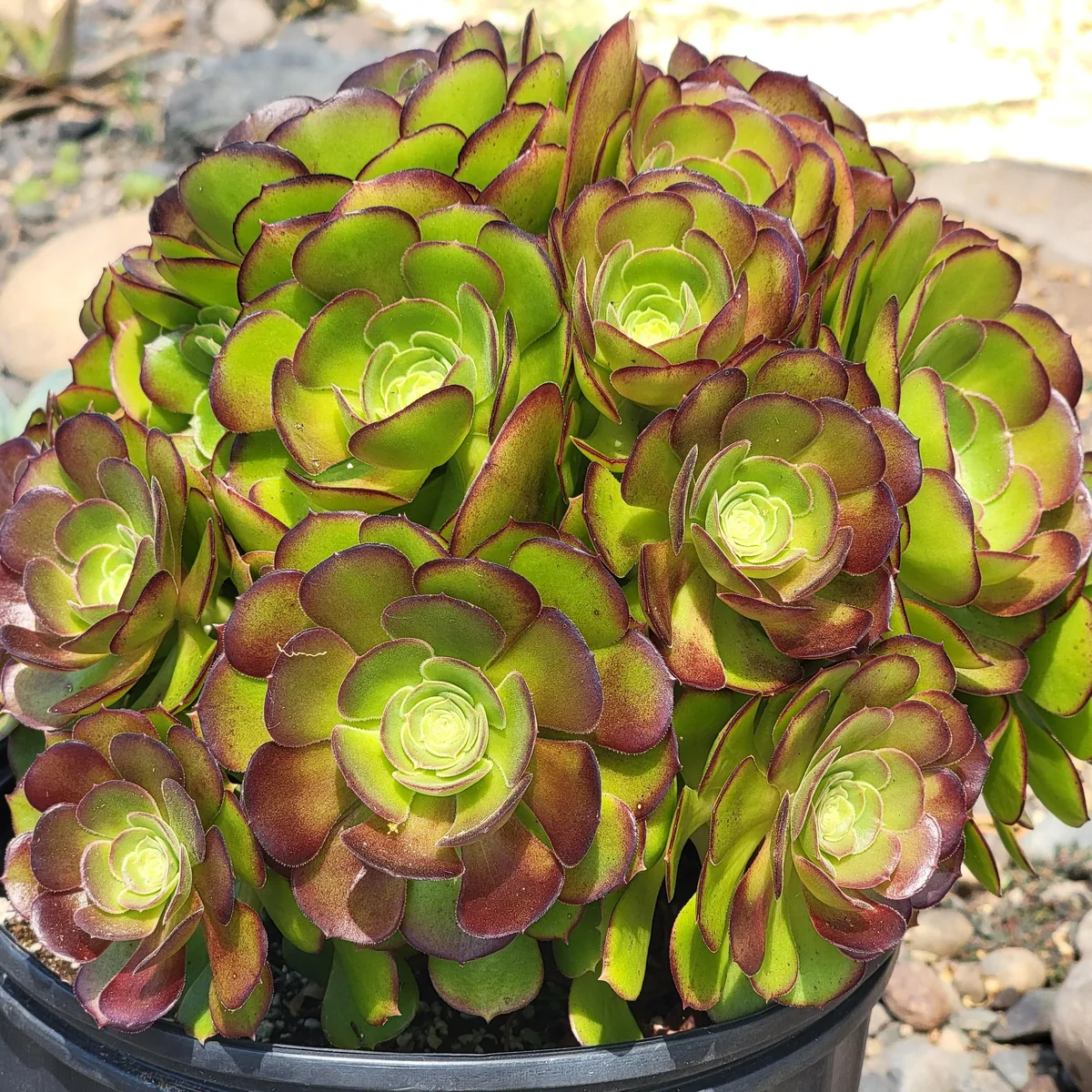
| Care difficulty | 2 / 5 |
|---|---|
| Watering schedule | Water thoroughly only when growing medium is fully desiccated |
| Sunlight requirements | Full sun |
| Ideal temperature | 12 – 24 °C |
| Soil type | Loam · Sand |
| Soil pH | Acid · Alkaline · Neutral |
| Soil moisture | Well drained |
| Fertilizing | Highly diluted low-nitrogen succulent feed monthly warm growth months |
| Toxicity | Information to be completed |
How to Water dark purple houseleek tree?
Tree aeonium 'Atropurpureum' thrives in its native semi-arid climate, requiring minimal watering to mimic its drought-adapted lifestyle. This succulent is adept at conserving water within its fleshy leaves, exhibiting a preference for drier conditions. Watering should occur once every three weeks, ensuring the soil has time to dry out between sessions. As an outdoor plant often favored for rockeries or Mediterranean gardens, tree aeonium 'Atropurpureum''s waxy, purplish foliage provides a stunning contrast against arid landscapes and requires little supplemental hydration beyond natural rainfall.
Learn more →What Are the Sunlight Requirements for dark purple houseleek tree?
Tree aeonium 'Atropurpureum' thrives in full sunlight, which bolsters its growth, enhances leaf coloration, and maximizes flowering potential. While it can tolerate partial sun, reduced light may lead to less vibrant foliage and diminished flowering. Tree aeonium 'Atropurpureum''s leaves can adapt by deepening their hue in intense light, serving as a protective mechanism against sunburn. Ideally grown outdoors, tree aeonium 'Atropurpureum' should be positioned in locations that receive several hours of direct light daily. In lower light, tree aeonium 'Atropurpureum' may exhibit leggy growth, indicating a need for brighter conditions.
Learn more →What Is the Ideal Temperature Range for dark purple houseleek tree?

Tree aeonium 'Atropurpureum' exhibits noteworthy resilience to temperature variations, tolerating extremes as low as 0℃ (32℉) and as high as 43℃ (109℉). This adaptability to both cold and heat significantly impacts its care; in temperatures below freezing, protective measures like frost cloths are essential. In excessive heat, shading and adequate watering are crucial. Symptoms of distress include leaf drop and color changes in cold, and wilting or scorching in heat. Address overcooling by moving the plant indoors or providing insulation, and counter overheating by increasing water supply and reducing sun exposure.
Learn more →What Soil Is Best for dark purple houseleek tree?
Loose, ventilated soil is very important for the growth of tree aeonium 'Atropurpureum'. Generally speaking, the soil is divided into three layers. From top to bottom: the top deco layer, the middle planting layer, and the lower hydrophobic layer. Each requires different types of soils. The top deco soil is paved on the soil surface for the decoration and fixation of plants. Some can prevent diseases and insect pests. When it's completely dry, it's time to water. There are many types of soil that can be used as top deco soil, such as white pebble, akadama soil, kiryuu sands, kanuma soil, etc. Choose it according to specific pots and plants. The middle layer soil fixes plants in place and provides nutrients for plants to grow. You can buy succulent planting soil from a store, or buy soil materials to mix yourself. The common soil formulation for this layer is peat moss:perlite:volcanic rock:vermiculite = 4:2:2:2. The soil of the lower hydrophobic layer is placed at the bottom of the flowerpot or garden hole to evacuate the excess water in the succulent root system and prevent the root system from rotting due to water accumulation. The hydrophobic layer can be made of ceramsite, volcanic stone, or other large-scale culture media. Coal slag or charcoal are also good choices. If it is planted in the garden, make sure the bottom drainage layer has good water permeability.
- Soil type
- Loam · Sand
- Soil pH
- Acid · Alkaline · Neutral
What Are the Moisture Requirements for dark purple houseleek tree?
Well drained
Learn more →How to Fertilize dark purple houseleek tree?

Most succulent plants are used to growing in the wild, where the environment is poor, so they do not need fertilization in their growth cycle. You can add a little slow-release fertilizer in early summer, but it's fine if you do not apply fertilizer at all. Don't fertilize during dormancy, because too many nutrients that it can't absorb may damages its growth.
Learn more →How to Prune dark purple houseleek tree?

Known for its striking rosettes and dark foliage, tree aeonium 'Atropurpureum' benefits greatly from strategic pruning. Optimal pruning should occur in early spring, promoting healthy growth and more vibrant leaves. Remove any dead or leggy stems to encourage bushier growth and improved air circulation. Pruning also helps in shaping the plant and maintaining its size. Regular pruning can enhance the overall appearance of tree aeonium 'Atropurpureum', preventing it from becoming too sprawling or unruly.
Learn more →How to Propagate dark purple houseleek tree?

Tree aeonium 'Atropurpureum' is a succulent known for its rosettes of dark purple leaves, lending it a unique appeal in gardens and containers. Propagation is typically achieved through cuttings, a straightforward method where rosettes or stem sections are removed and allowed to callous over before planting in well-draining soil. Success with tree aeonium 'Atropurpureum' relies on avoiding excessive moisture that can lead to rot. Careful handling and indirect sunlight can foster robust root development for healthy growth.
Learn more →How to Transplant dark purple houseleek tree?
Tree aeonium 'Atropurpureum' thrives when transplanted between early to late spring due to favorable growth conditions. Choose a sunny location with well-drained soil. Ensure minimal root disturbance for successful acclimatization and better growth.
Learn more →How to Plant dark purple houseleek tree?
When planting, add the hydrophobic layer to the flowerpot first, and then a small amount of soil of the planting layer. Then spread out the roots and put them in. Cover the root with planting soil slowly. Add the top decorative layer, and finally, water once. To plant in the garden, dig a pit 1.5-2 times the size of the root system first, and then follow the above steps. In order to make it grow better and faster, or if the roots are too dense or unhealthy, it needs to be repotted. Repot in spring and fall. Before repotting, stop watering a few days in advance. Once the soil is dried, you can gently knock the pot outside. Or you can use a knife to separate the soil from the pot. Gently pull the plant up slightly to ease it out of the pot, and then follow the steps described above. Though you can plant different colors of succulent plants together, avoid planting succulent plants with different growth habits together. Some succulents need water in the summer, while others don't. If they are planted together, one will become sick due to excessive watering, while the other may wither due to insufficient water.
Learn more →Common Pests & Diseases

Diseases
Generally disease-free
Pests
May be susceptible to aphids and mealybugs
Explore the plant health library →Troubleshooting
Soft Basal Rot vs. Wrinkled Dehydrated Leaves or Stems
dark purple houseleek tree (Aeonium arboreum 'Atropurpureum') stores water in fleshy tissues and relies on fast-draining mineral soil; waterlogged roots in cool or heavy compost quickly cause basal rot.
| What you notice | Possible explanation | What to check next |
|---|---|---|
| Base of stem or lower leaves turns dark brown/black, soft, and translucent while soil stays damp | Root or stem rot from overwatering, poor drainage, or watering during cool dormancy | Check pot drainage holes, inspect lower soil wetness, and test stem firmness gently |
| Fleshy leaves or stems look wrinkled, deflated, or limp while gritty soil is bone dry during active growth | Underwatering as the plant draws on stored tissue moisture | Check deep soil dryness and confirm daytime temperatures are in the active growth range |
- Pot in a sharply drained cactus/succulent compost (amended with coarse sand, grit, pumice, or perlite) in a container with open drainage holes.
- Follow seasonal moisture cues: Water thoroughly only when growing medium is fully desiccated.
- If rot develops at the base, cut away healthy upper stems or offsets with a sterilized blade, let cut ends dry and callous for several days, and root in fresh gritty mix.
Stop watering immediately if soft black rot spreads from the base, and discard rotted tissues and wet old soil.
Etiolated Green Growth or Mealybugs and Scale
Insufficient direct sunlight stretches new growth and dulls natural stress coloration in dark purple houseleek tree (Aeonium arboreum 'Atropurpureum'), while mealybugs and scale often hide in leaf axils or around roots.
| What you notice | Possible explanation | What to check next |
|---|---|---|
| New growth stretches pale green with wide internodes instead of staying compact and richly colored | Insufficient bright direct sunlight | Evaluate daily hours of direct sun exposure at the current site |
| White cottony tufts, sticky honeydew, or hard brown bumps along stems and leaf bases | Sap-sucking pests (May be susceptible to aphids and mealybugs) | Inspect stem junctions, leaf undersides, and the soil line closely |
- Acclimate gradually to full sun so new growth develops compact form and natural coloration without sudden sunburn.
- Isolate infested plants and dab visible mealybugs or scale with rubbing alcohol on a cotton swab, or apply insecticidal soap per label directions.
- Protect frost-tender plants indoors or under cover before freezing weather arrives.
Already stretched stems will not shrink back, though compact healthy growth will resume once bright light is restored.