
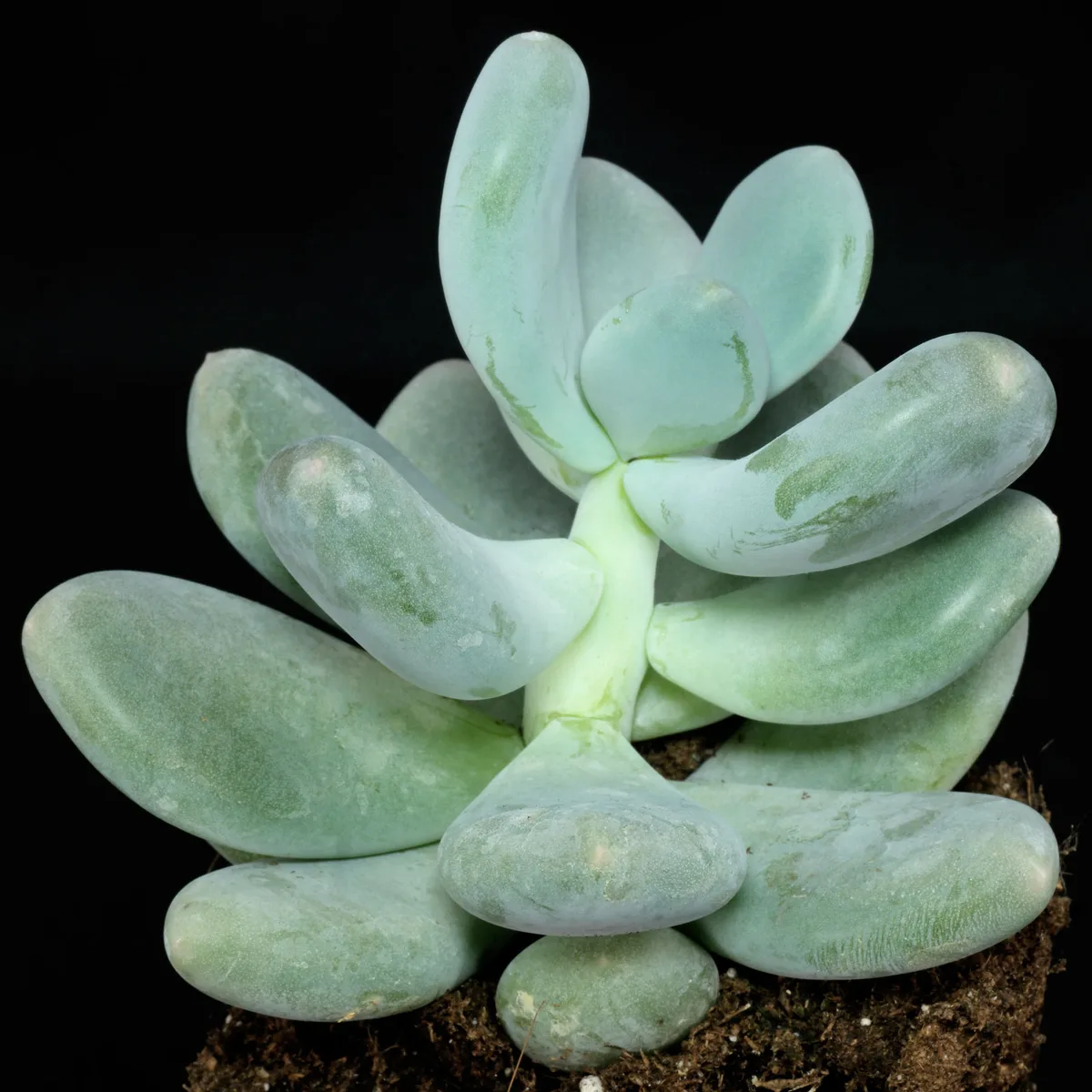
moonstones
Also known as: sugared almond plum
A clump-forming succulent producing short stems of fleshy, white-frosted glaucous leaves. In spring it bears an arching spike of red flowers inside glaucous outer petals
Scientific classification
- Species
- moonstones (Pachyphytum oviferum)
- Genus
- Pachyphytum
- Family
- Crassulaceae
- Order
- Saxifragales
- Class
- Magnoliopsida
- Phylum
- Magnoliophyta
- Information to be completed
- Toxicity
- Cactus Succulent
- Plant type
- 0.1-0.5 metres
- Height
- 0.1-0.5 metres
- Spread
- Evergreen
- Foliage
- Clump forming
- Habit
- Spring · Summer · Autumn · Winter
- Season of interest
- Full sun
- Sunlight
- 18 – 28 °C
- Ideal temperature









moonstones pictures
Distribution of moonstones
Distribution map
- Native
- Introduced
- Cultivated
Source:WCVP v16 · Royal Botanic Gardens, Kew · CC BY 3.0 · Boundaries:WGSRPD / TDWG
moonstones care guide
- Water thoroughly only when soil is completely dry; avoid water on leaves.
- Watering
- Full sun
- Sunlight
- 18 – 28 °C
- Ideal temperature

Watering
Water thoroughly only when soil is completely dry; avoid water on leaves.
Fertilizing
 Fertilizing
Monthly with a diluted succulent fertilizer during spring and summer.
Pruning
 Pruning
No pruning required
Propagation
 Propagation
Propagate by seed sown in spring at 21°C, or by leaf cuttings in summer
Growing
 Growing
Grow in pots of cactus compost in a greenhouse (minimum 5°C), or as a houseplant on a sunny windowsill. Water moderately while in growth and keep almost dry at other times. Apply a low-nitrogen fertiliser every 6-8 weeks in spring and summer. See houseplant cacti and succulent cultivation for further information
Common pests and diseases
Diseases
Generally disease-free
Pests
Generally pest-free
Explore the plant health library →




