
African Violet
Also known as: African Violet, Saintpaulia
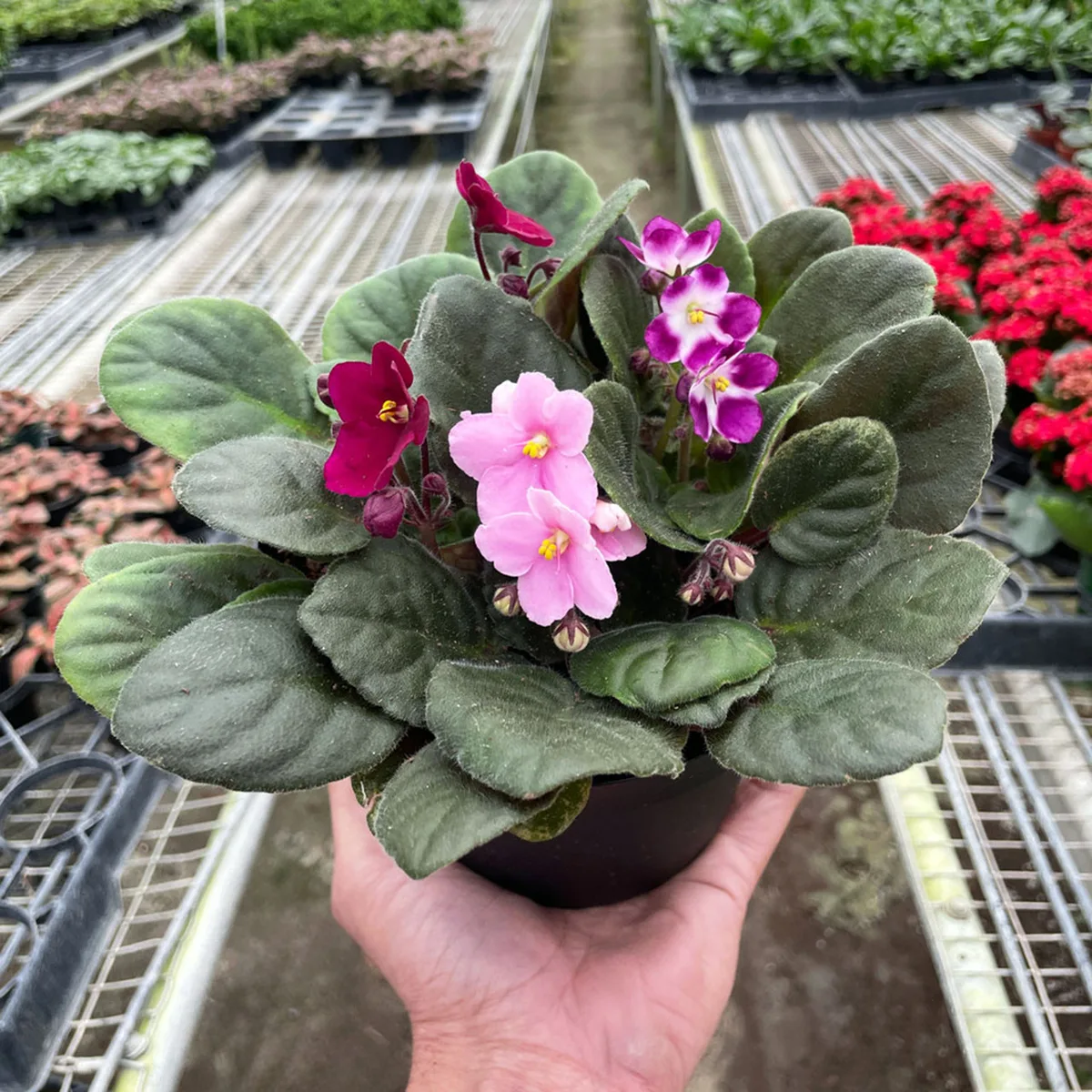
African Violet is a compact, stemless perennial with a rosette of hairy, oval to rounded leaves. It produces clusters of five-petaled flowers in shades of violet, pink, white, blue, or purple, often with yellow centers. The plant typically grows to 15 cm tall and wide, blooming repeatedly under proper care. Its long flowering period and variety of colors make it a popular indoor ornamental.
Scientific classification
- Species
- African Violet (Saintpaulia ionantha)
- Genus
- Saintpaulia
- Family
- Gesneriaceae
- Order
- Lamiales
- Class
- Magnoliopsida
- Phylum
- Tracheophyta
- Non-toxic
- Toxicity
- Houseplants
- Plant type
- 0.1 - 0.3 metres
- Height
- 0.2 - 0.3 metres
- Spread
- Evergreen
- Foliage
- Clump forming
- Habit
- Spring · Summer · Autumn
- Season of interest
- Bright indirect light
- Sunlight
- 18 – 27 °C
- Ideal temperature









African Violet pictures
Distribution of African Violet
Distribution map
- Native
- Introduced
- Cultivated
Source:WCVP v16 · Royal Botanic Gardens, Kew · CC BY 3.0 · Boundaries:WGSRPD / TDWG
Toxicity
Non-toxic
African Violet care guide
- Water from bottom or use room-temperature water on soil; avoid leaves
- Watering
- Bright indirect light
- Sunlight
- 18 – 27 °C
- Ideal temperature

Watering
Water from bottom or use room-temperature water on soil; avoid leaves
Fertilizing
 Fertilizing
Every two weeks with African violet specific fertilizer year-round
Pruning
 Pruning
Remove faded flowers and yellowed or damaged leaves regularly to encourage continued blooming and maintain a tidy appearance. Cut back the entire rosette lightly if it becomes leggy.
Propagation
 Propagation
Propagate by leaf cuttings: select a healthy leaf with a 2–3 cm petiole, insert the petiole into moist potting mix or water, and place in bright indirect light. Roots and new plantlets will form in 4–6 weeks at 18–24°C. Alternatively, divide offsets during repotting in spring. Sow seeds at 20°C for seedling propagation.
Growing
 Growing
Grow in bright, indirect light; direct sun can scorch the leaves. Use a well-drained, peat-based potting mix and water from the bottom to avoid wetting the foliage—lettuce the plant soak up water for 30 minutes, then drain. Keep the soil consistently moist but not waterlogged, and maintain high humidity by placing on a pebble tray or using a room humidifier. Fertilize every 2–4 weeks with a balanced liquid fertilizer diluted to half strength. Avoid temperature below 10°C and cold drafts.
Common pests and diseases
Diseases
Susceptible to Botrytis blight (gray mold) and root rot caused by overwatering or poor air circulation. Crown rot may also occur if water sits on the crown.
Pests
Common pests include aphids, spider mites, whiteflies, and thrips. Mealybugs may also infest leaves and stems.
Explore the plant health library →




