
Tiger Aloe
Also known as: Tiger Aloe, Partridge Breast Aloe
Aloe variegata is a compact succulent perennial forming rosettes of triangular, dark green leaves with irregular white banding and small teeth along the margins. In spring, it produces tall racemes of tubular orange-pink flowers. Its striking patterned foliage and low-growing habit make it a popular choice for indoor containers and rockeries.
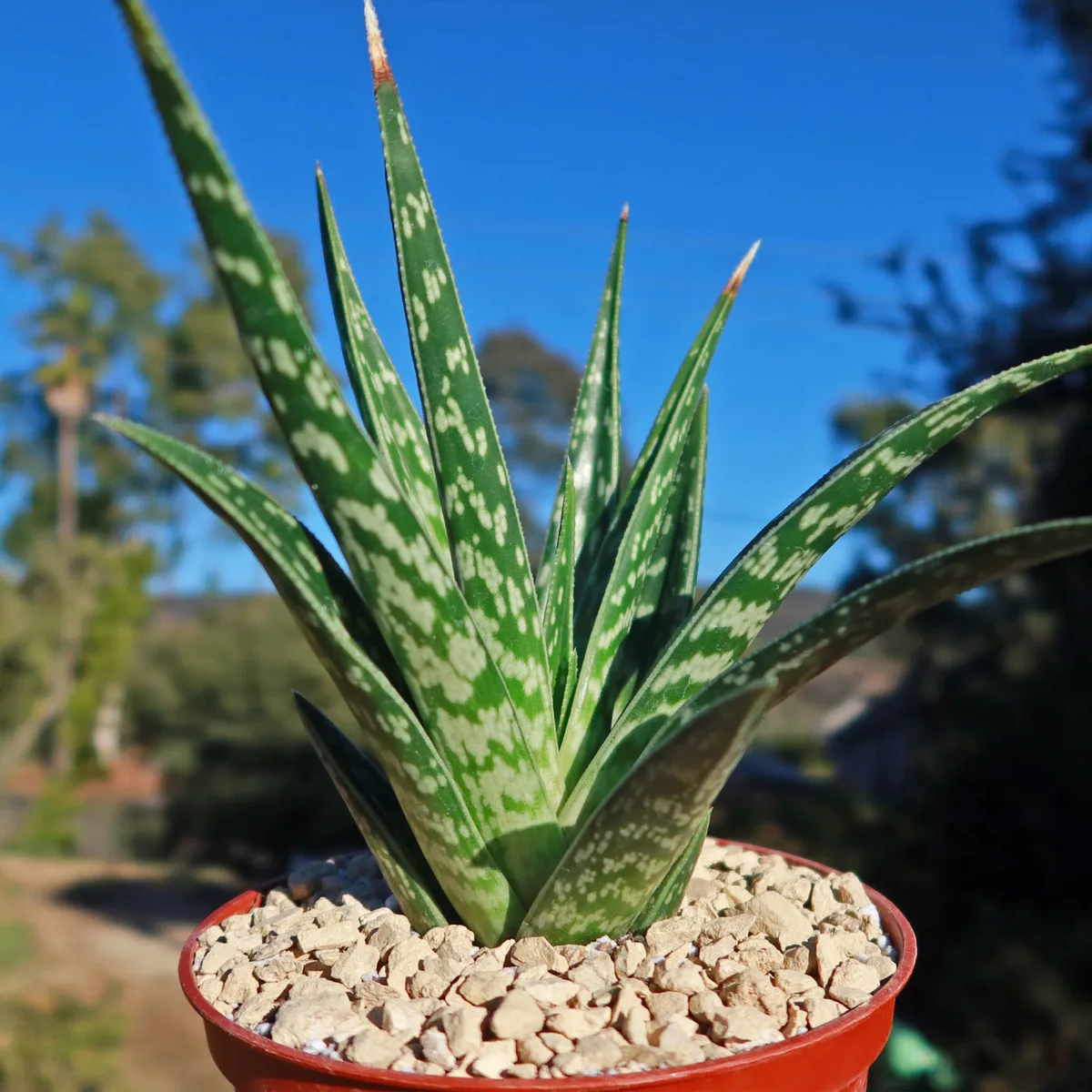
Scientific classification
- Species
- Tiger Aloe (Aloe variegata)
- Genus
- Information to be completed
- Family
- Asphodelaceae
- Toxic to pets if ingested; sap may cause skin irritation.
- Toxicity
- Succulent · Houseplants
- Plant type
- 0.3 - 0.5 metres
- Height
- 0.2 - 0.4 metres
- Spread
- Evergreen
- Foliage
- Clump forming
- Habit
- Spring
- Season of interest
- Bright indirect light
- Sunlight
- 18 – 28 °C
- Ideal temperature









Tiger Aloe pictures
Distribution of Tiger Aloe
Distribution map
South Africa (Cape Province)
Toxicity
Toxic to pets if ingested; sap may cause skin irritation.
Tiger Aloe care guide
- Water thoroughly when soil is dry, allow to dry completely between waterings
- Watering
- Bright indirect light
- Sunlight
- 18 – 28 °C
- Ideal temperature

Watering
Water thoroughly when soil is dry, allow to dry completely between waterings
Fertilizing
 Fertilizing
Every 4 weeks during growing season (spring-summer)
Pruning
 Pruning
Remove dead leaves and spent flower stalks as needed.
Propagation
 Propagation
Propagate by offsets (pups) removed in spring or early summer. Allow cuttings to callous for a few days before planting in well-draining soil. Keep at 20-25°C.
Growing
 Growing
Grow in well-drained, sandy or loamy soil. Water only when the soil is completely dry, and reduce watering in winter to prevent rot. Provide bright indirect light; avoid direct afternoon sun which can scorch leaves. Feed with a balanced liquid fertiliser every 4 weeks during the growing season. Minimum temperature 5°C; protect from frost.
Common pests and diseases
Diseases
Susceptible to root rot if overwatered; watch for fungal leaf spots.
Pests
Common pests include mealybugs and scale insects.
Explore the plant health library →




