
Siberian bugloss 'Looking Glass'
Also known as: Information to be completed
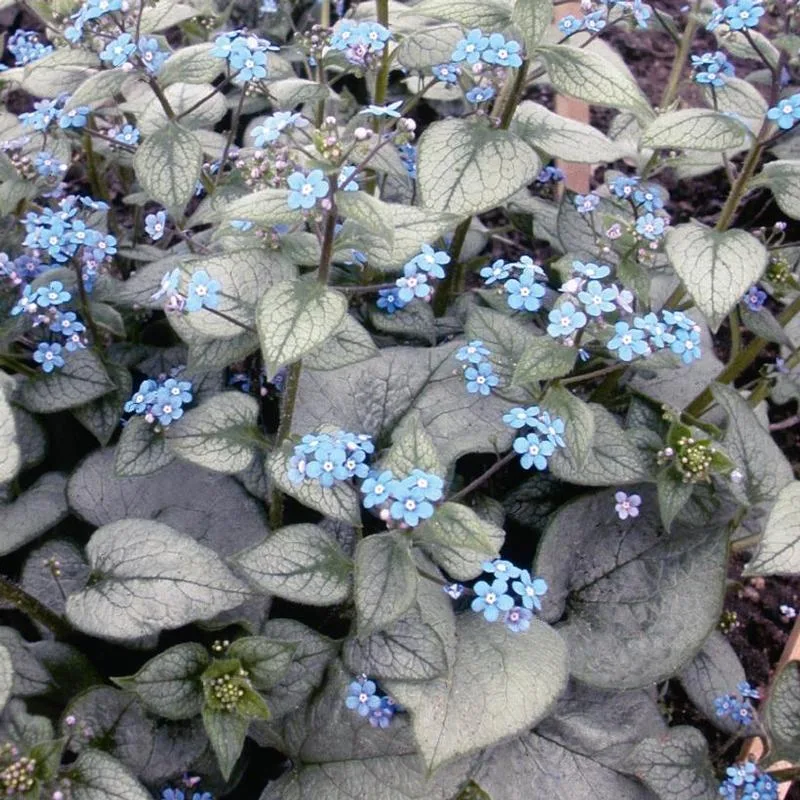
A herbaceus perennial with mostly silvery foliage without a green trim, sparse green veining, and floriferous delicate 5-petaled flower sprays from February to June. An excellent plant for ground cover
Scientific classification
- Species
- Siberian bugloss 'Looking Glass' (Brunnera macrophylla 'Looking Glass')
- Genus
- Brunnera
- Family
- Boraginaceae
- Order
- Boraginales
- Class
- Magnoliopsida
- Phylum
- Magnoliophyta
- Information to be completed
- Toxicity
- Herbaceous Perennial
- Plant type
- 0.1-0.5 metres
- Height
- 0.1-0.5 metres
- Spread
- Deciduous
- Foliage
- Clump forming
- Habit
- Spring · Summer · Winter
- Season of interest
- Full shade · Full sun · Partial shade
- Sunlight
- Information to be completed
- Ideal temperature









Siberian bugloss 'Looking Glass' pictures
Distribution of Siberian bugloss 'Looking Glass'
Distribution map
- Native
- Introduced
- Cultivated
Source:WCVP v16 · Royal Botanic Gardens, Kew · CC BY 3.0 · Boundaries:WGSRPD / TDWG
Siberian bugloss 'Looking Glass' care guide
- Keep rich woodland soil evenly moist, never baking dry in summer
- Watering
- Full shade · Full sun · Partial shade
- Sunlight

Watering
Keep rich woodland soil evenly moist, never baking dry in summer
Fertilizing
 Fertilizing
Light balanced feed monthly during spring and early summer growth
Pruning
 Pruning
Older leaves can be cut back in spring and during growing season to encourage new growth. Leave the plant to age in autumn to protect the crown. If overcrowded after a few years, in spring dig up carefully with a fork, tease out roots and select the heathiest clumps for replanting.
Propagation
 Propagation
Propagate from roots in spring
Growing
 Growing
Best cultivated in full or dappled shade in woodland conditions which do not dry out. In full sun keep soil moist, mulched.
Common pests and diseases
Diseases
Generally disease-free
Pests
May be attacked by slugs and snails
Explore the plant health library →




