
white-flowered chives
Also known as: Information to be completed
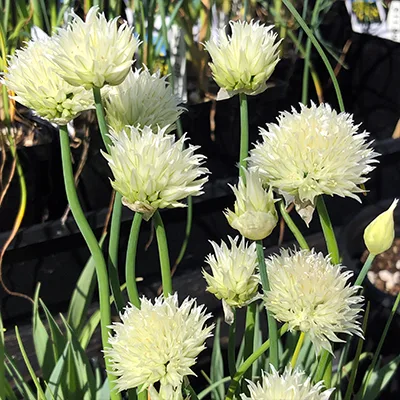
A clump-forming, bulbous herbaceous perennial, up to 30cm high, with edible, hollow, cylindrical, grass-like leaves, and spherical, pure white flowerheads, 1.5cm across, in early summer
Scientific classification
- Species
- white-flowered chives (Allium schoenoprasum f. albiflorum)
- Genus
- Allium
- Family
- Amaryllidaceae
- Order
- Asparagales
- Class
- Liliopsida
- Phylum
- Magnoliophyta
- Information to be completed
- Toxicity
- Herbs - Culinary
- Plant type
- 0.1-0.5 metres
- Height
- 0.1-0.5 metres
- Spread
- Deciduous
- Foliage
- Clump forming
- Habit
- Spring · Summer · Autumn
- Season of interest
- Full sun · Partial shade
- Sunlight
- Information to be completed
- Ideal temperature









white-flowered chives pictures
Distribution of white-flowered chives
Distribution map
- Native
- Introduced
- Cultivated
Source:WCVP v16 · Royal Botanic Gardens, Kew · CC BY 3.0 · Boundaries:WGSRPD / TDWG
white-flowered chives care guide
- Water moderately in growth, keep drier after flowering
- Watering
- Full sun · Partial shade
- Sunlight

Watering
Water moderately in growth, keep drier after flowering
Fertilizing
 Fertilizing
Light bulb feed in spring before flowering
Pruning
 Pruning
No pruning required, except cutting the leaves for eating, preferably with scissors, and deadheading
Propagation
 Propagation
Propagate by seed (may not come true if non-white chives are growing nearby) or by division during spring or autumn into groups of 5 or 6 plants, and replant at spacings of 20-30cm
Growing
 Growing
Grow in full sun or partial shade; for edible leaves, grow in moist but well-drained medium soil, while for flowers, grow in lighter and drier soil. May have the potential to become a nuisance if not managed well. See chive cultivation for further advice
Common pests and diseases
Diseases
May be susceptible to onion white rot and onion downy mildew
Pests
May be susceptible to allium leaf miner and onion fly
Explore the plant health library →




