
Tillandsia dyeriana
Also known as: Information to be completed
An epiphytic perennial bromeliad to 35cm tall, with funnel-shaped rosettes of tongue-shaped, pointed leaves with reddish-brown spots. In summer it produces a flowerspike composed of long-lasting, waxy, red bracts from which emerge tubular white flowers
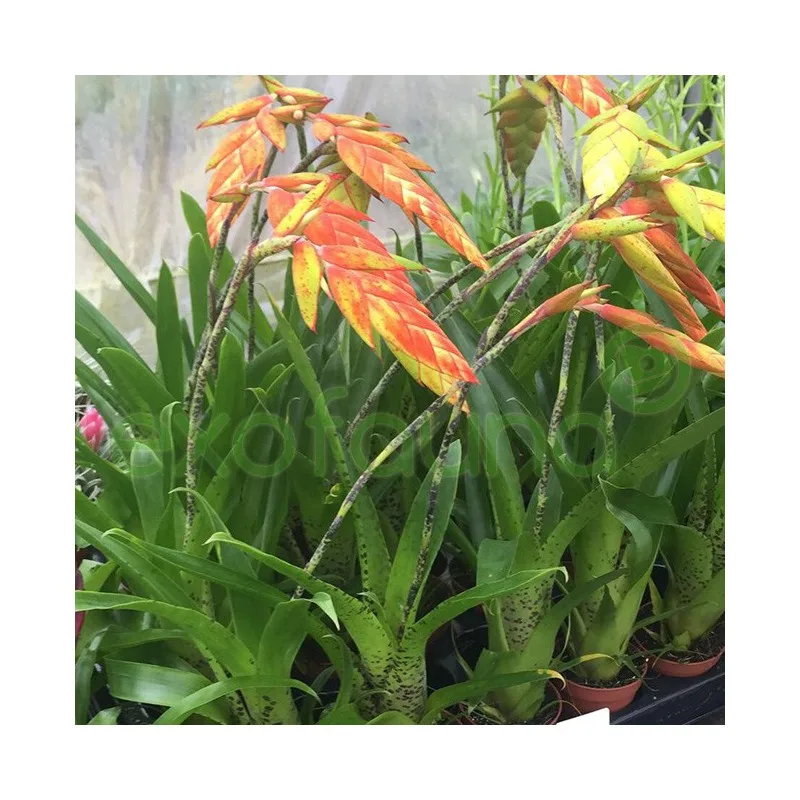
Scientific classification
- Species
- Tillandsia dyeriana (Tillandsia dyeriana)
- Genus
- Tillandsia
- Family
- Bromeliaceae
- Order
- Poales
- Class
- Liliopsida
- Phylum
- Magnoliophyta
- Information to be completed
- Toxicity
- Houseplants
- Plant type
- 0.1-0.5 metres
- Height
- 0.1-0.5 metres
- Spread
- Evergreen
- Foliage
- Tufted
- Habit
- Spring · Summer · Autumn · Winter
- Season of interest
- Partial shade
- Sunlight
- Information to be completed
- Ideal temperature









Tillandsia dyeriana pictures
Distribution of Tillandsia dyeriana
Distribution map
- Native
- Introduced
- Cultivated
Source:WCVP v16 · Royal Botanic Gardens, Kew · CC BY 3.0 · Boundaries:WGSRPD / TDWG
Tillandsia dyeriana care guide
- Moderate regular watering, allowing brief slight drying between soakings
- Watering
- Partial shade
- Sunlight

Watering
Moderate regular watering, allowing brief slight drying between soakings
Fertilizing
 Fertilizing
Balanced perennial feed every four weeks from spring through summer
Pruning
 Pruning
No pruning required
Propagation
 Propagation
Propagate by seed sown at 27°C in spring, onto bundles of conifer twigs and sphagnum moss; mist daily. Detach offsets in spring
Growing
 Growing
Under glass, grow epiphytically, or in pots of free-draining compost composed of equal parts of orchid compost, perlite and coir fibre. Position in bright, indirect light, with moderate to high humidity. From late spring to late summer water moderately and apply a balanced foliar feed monthly. Water sparingly in winter. See Bromeliad cultivation
Common pests and diseases
Diseases
Generally disease-free
Pests
Generally pest-free
Explore the plant health library →




