
marguerite 'Reflection Pink'
Also known as: Information to be completed
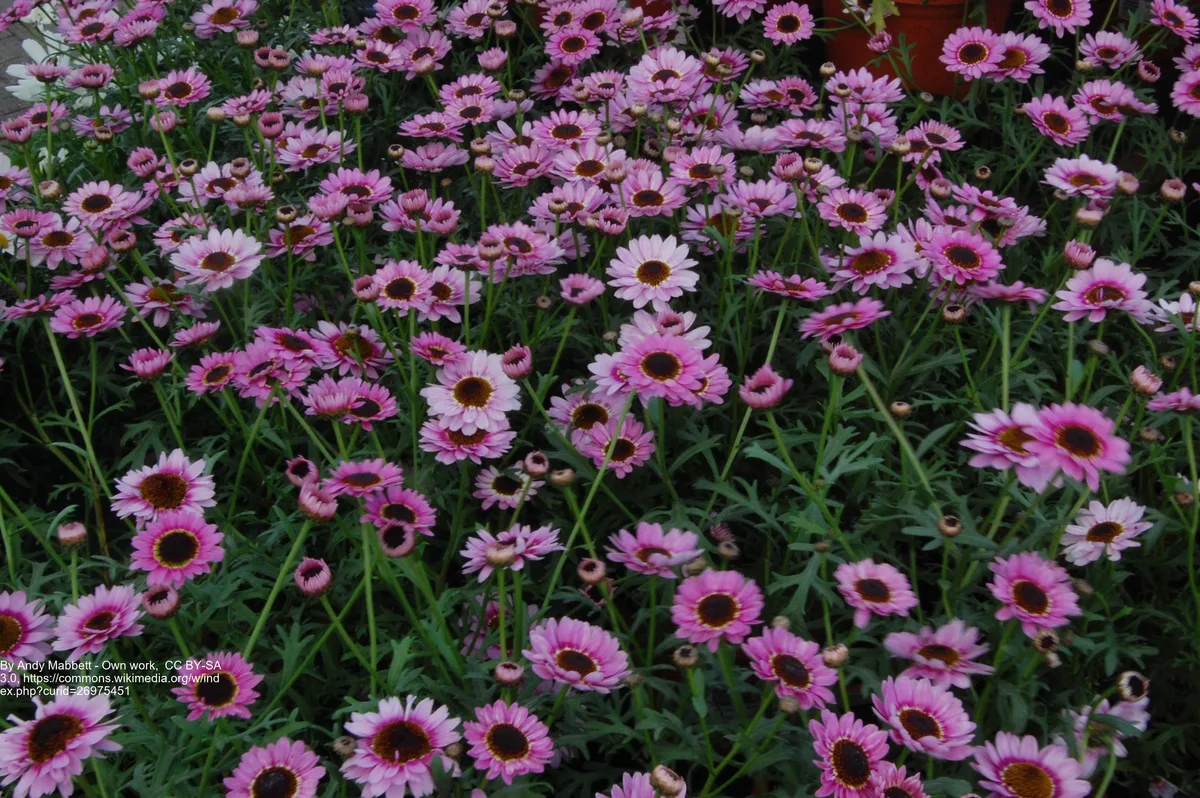
A tender evergreen subshrub, often grown as an annual, forming a mound of lobed and divided, grey-green foliage to around 50cm high. Large daisy-like flowers, with shell pink petals that are darker pink near the centre, and large yellow-brown central disks, are borne above the foliage from late spring until early autumn
Scientific classification
- Species
- marguerite 'Reflection Pink' (Argyranthemum 'Reflection Pink')
- Genus
- Argyranthemum
- Family
- Asteraceae
- Information to be completed
- Toxicity
- Bedding · Shrubs
- Plant type
- 0.1-0.5 metres
- Height
- 0.1-0.5 metres
- Spread
- Evergreen
- Foliage
- Bushy
- Habit
- Spring · Summer · Autumn · Winter
- Season of interest
- Full sun
- Sunlight
- Information to be completed
- Ideal temperature









marguerite 'Reflection Pink' pictures
Distribution of marguerite 'Reflection Pink'
Distribution map
Information to be completed
Information to be completed
Culture
Information to be completed
Toxicity
Information to be completed
Quick identification of marguerite 'Reflection Pink'
Information to be completed
marguerite 'Reflection Pink' care guide
- Water regularly, allowing the soil to dry slightly between waterings.
- Watering
- Full sun
- Sunlight
- Information to be completed
- Ideal temperature

Watering
Water regularly, allowing the soil to dry slightly between waterings.
Fertilizing
 Fertilizing
Apply a balanced liquid fertilizer every 2-3 weeks during the growing season.
Pruning
 Pruning
Shorten flowered shoots to about 1.5–2.5 cm from the previous year's growth. If flowering is on last year's growth, prune after flowering; if on current-year growth, prune the following early to mid-spring. Remove spent flowers regularly.
Propagation
 Propagation
Propagate by softwood cuttings in spring, and semi-hardwood cuttings of non-flowering shoots in summer
Growing
 Growing
Grow in moderately fertile, well-drained soil in full sun. Pinch out growing tips to keep compact. Plants will die back as temperatures drop; a deep dry mulch may protect the rootstock from light frosts, but it is advisable to take cuttings to insure against winter losses, or plant in containers that may be moved indoors over winter
People also ask
Information to be completed
Common pests and diseases
Diseases
May be susceptible to crown gall
Pests
May be susceptible to chrysanthemum leaf miner
Explore the plant health library →




