
New England aster 'Helen Picton'
Also known as: Information to be completed
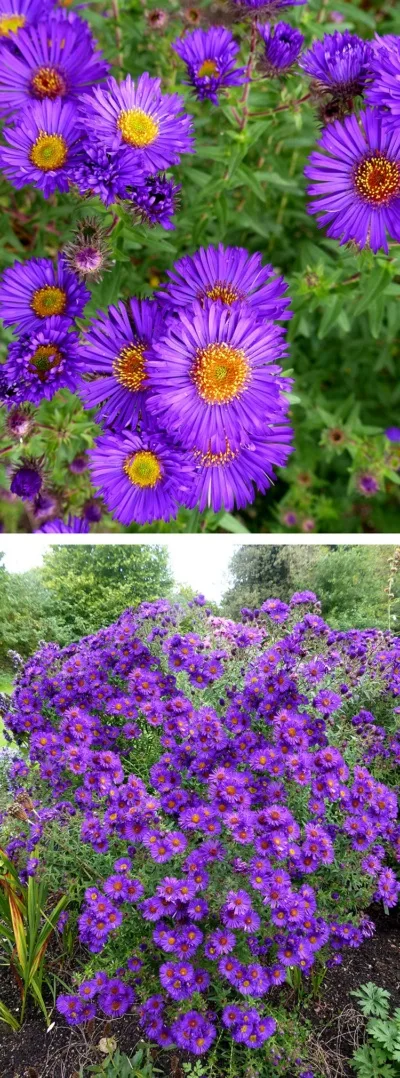
Helen Picton' is a clump-forming herbaceous perennial to about 1m with narrow , mid-green leaves. Relatively large, rich purple flowers with yellow to dark orange centres open from late summer to mid-autumn
Scientific classification
- Species
- New England aster 'Helen Picton' (Symphyotrichum novae-angliae 'Helen Picton')
- Genus
- Symphyotrichum
- Family
- Asteraceae
- Order
- Asterales
- Class
- Magnoliopsida
- Phylum
- Magnoliophyta
- Information to be completed
- Toxicity
- Herbaceous Perennial
- Plant type
- 1-1.5 metres
- Height
- 0.5-1 metres
- Spread
- Deciduous
- Foliage
- Clump forming
- Habit
- Spring · Summer · Autumn
- Season of interest
- Full sun · Partial shade
- Sunlight
- Information to be completed
- Ideal temperature









New England aster 'Helen Picton' pictures
Distribution of New England aster 'Helen Picton'
Distribution map
- Native
- Introduced
- Cultivated
Source:WCVP v16 · Royal Botanic Gardens, Kew · CC BY 3.0 · Boundaries:WGSRPD / TDWG
New England aster 'Helen Picton' care guide
- Keep soil consistently moist, especially during dry summer months, for best flowering.
- Watering
- Full sun · Partial shade
- Sunlight

Watering
Keep soil consistently moist, especially during dry summer months, for best flowering.
Fertilizing
 Fertilizing
Apply a balanced granular fertilizer in spring and liquid feed mid-summer.
Pruning
 Pruning
Cut stems back close to the ground in late autumn
Propagation
 Propagation
Propagate by division in spring, replanting only vigorous young shoots
Growing
 Growing
Grow in rich, fertile, moisture-retentive soil, in full sun if the soil remains moist throughout the growing season, or in partial shade; mulch every year after cutting down in late autumn. Divide every third year to retain vigour and flower quality
Common pests and diseases
Diseases
May be affected by fusarium foot rot, leaf spot, grey moulds and verticillium wilt. Has some resistance to powdery mildews
Pests
May be affected by eelworm, aphids, slugs and snails
Explore the plant health library →




