
bugloss 'Dropmore'
Also known as: Information to be completed
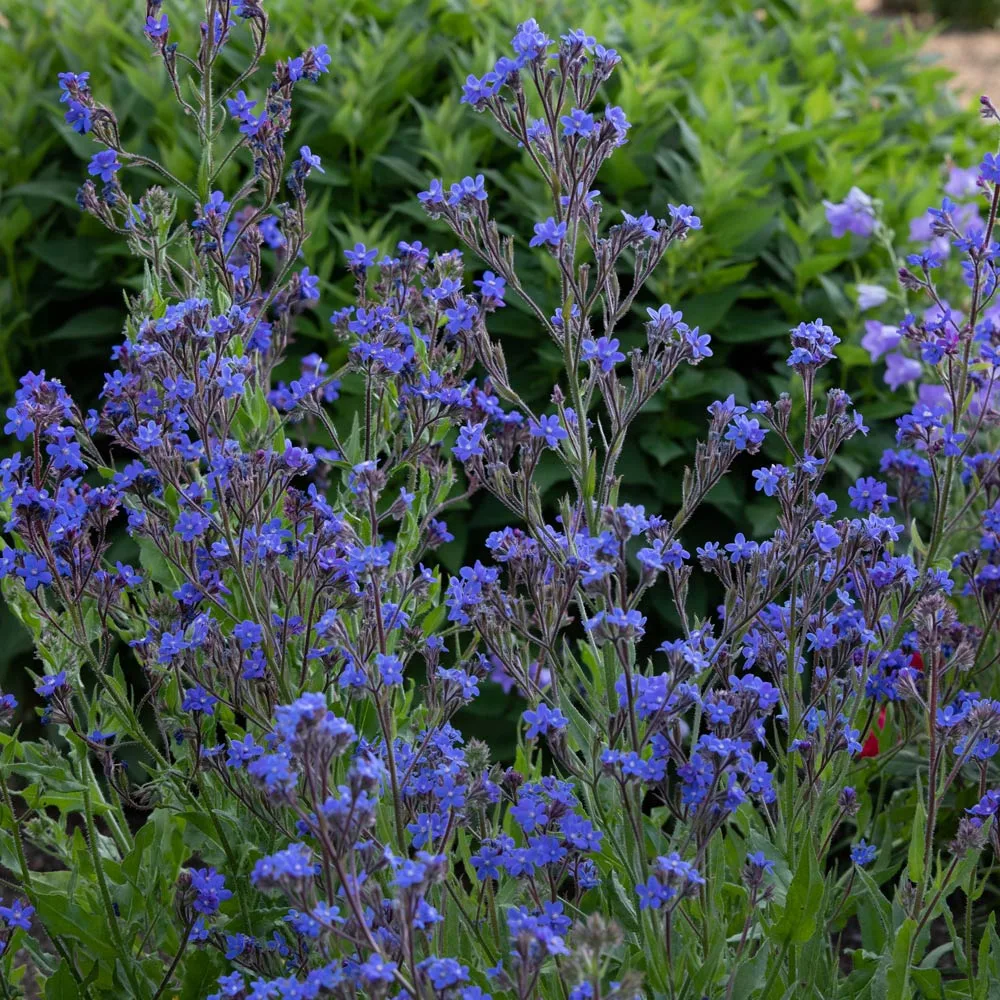
An erect, clump-forming, short-lived perennial with alternate, entire, stiffly hairy, linear-elliptic to lanceolate leaves which are sessile or clasping at the base. In late spring to early summer, intense blue flowers are borne in terminal spikes rising above the foliage.
Scientific classification
- Species
- bugloss 'Dropmore' (Anchusa azurea 'Dropmore')
- Genus
- Anchusa
- Family
- Boraginaceae
- Order
- Boraginales
- Class
- Magnoliopsida
- Phylum
- Magnoliophyta
- Information to be completed
- Toxicity
- Herbaceous Perennial
- Plant type
- 0.5-1 metres
- Height
- 0.1-0.5 metres
- Spread
- Deciduous
- Foliage
- Clump forming · Columnar upright
- Habit
- Spring · Summer
- Season of interest
- Full sun · Partial shade
- Sunlight
- Information to be completed
- Ideal temperature









bugloss 'Dropmore' pictures
bugloss 'Dropmore' care guide
- Moderate regular watering, avoid prolonged drought or waterlogging
- Watering
- Full sun · Partial shade
- Sunlight

Watering
Moderate regular watering, avoid prolonged drought or waterlogging
Fertilizing
 Fertilizing
Balanced feed in spring and light repeat in growth season
Pruning
 Pruning
Dead-head after the first flush of flowers to encourage a second flush. Cut back top-growth after flowering to encourage the development of overwintering basal rosettes.
Propagation
 Propagation
Propagate by seed, root cuttings in winter or by softwood cuttings from the base of young shoots in spring.
Growing
 Growing
Grows in any moderately fertile, moist but well-drained soil in full sun, although it can also tolerate partial shade. It thrives in moist soils but dislikes winter wet. Plants may require staking.
Common pests and diseases
Diseases
Can be susceptible to powdery mildews
Pests
Generally pest-free
Explore the plant health library →




