
dragon fruit
Also known as: night-blooming cereus; night-blooming cereus; pitahaya; pitaya; prickly withe; queen of the night; strawberry pear
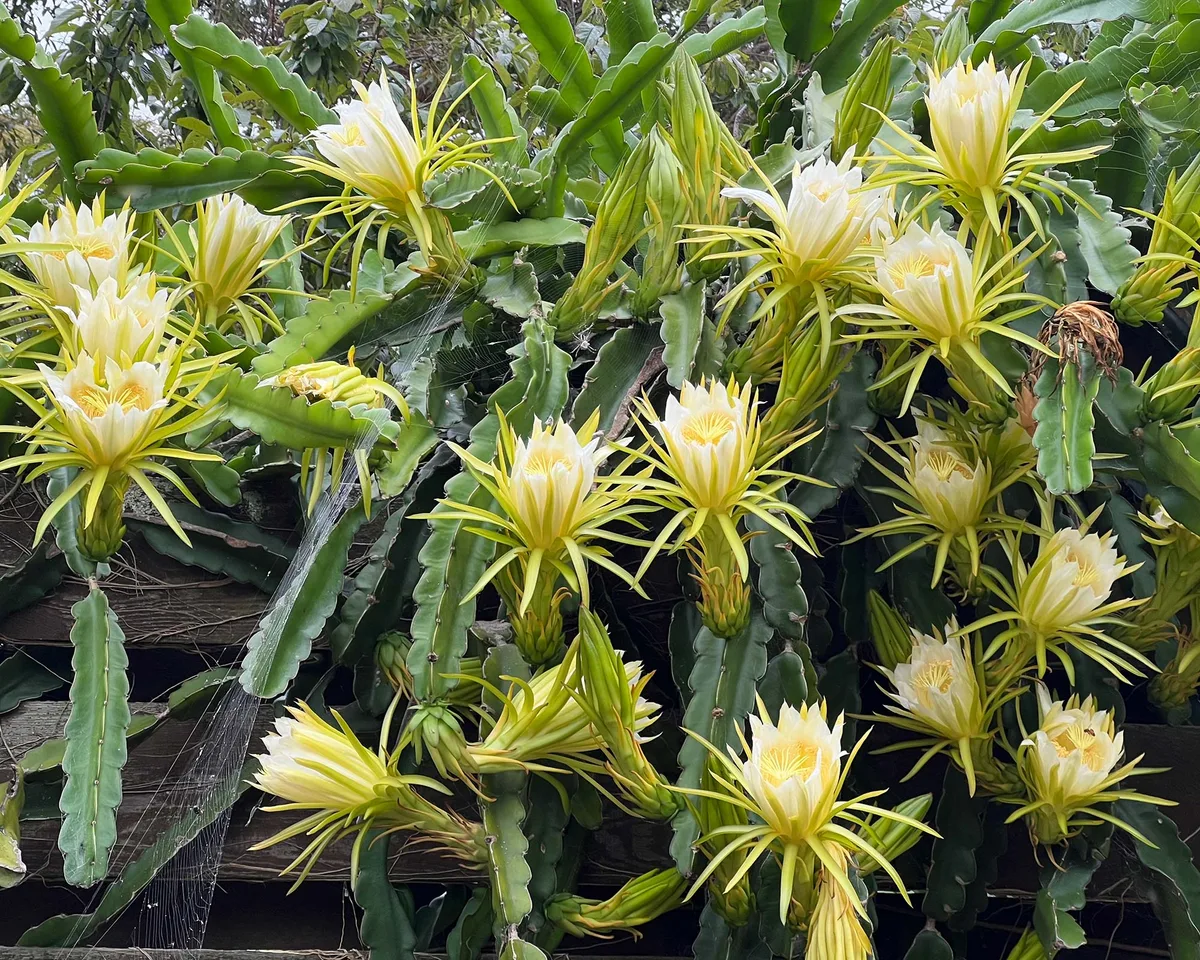
A vigorous, branching, epiphytic cactus with a scrambling habit and thick, jointed, three-angled stems with scalloped edges and fine grey-brown spines. Large, fragrant white flowers to 30cm across, with narrow, yellow-green outer segments, open at night in summer. If pollinated, these are followed by reddish pink edible fruits
Scientific classification
- Species
- dragon fruit (Hylocereus undatus)
- Genus
- Hylocereus
- Family
- Cactaceae
- Order
- Caryophyllales
- Class
- Magnoliopsida
- Phylum
- Magnoliophyta
- Information to be completed
- Toxicity
- Cactus Succulent
- Plant type
- 2.5-4 metres
- Height
- 2.5-4 metres
- Spread
- Evergreen
- Foliage
- Trailing
- Habit
- Spring · Summer · Autumn · Winter
- Season of interest
- Partial shade
- Sunlight
- 20 – 30 °C
- Ideal temperature









dragon fruit pictures
Distribution of dragon fruit
Distribution map
- Native
- Introduced
- Cultivated
Source:WCVP v16 · Royal Botanic Gardens, Kew · CC BY 3.0 · Boundaries:WGSRPD / TDWG
dragon fruit care guide
- Water deeply then dry substrate fully, drought-tolerant cactus vine
- Watering
- Partial shade
- Sunlight
- 20 – 30 °C
- Ideal temperature

Watering
Water deeply then dry substrate fully, drought-tolerant cactus vine
Fertilizing
 Fertilizing
Diluted low-nitrogen cactus feed monthly warm growing months
Pruning
 Pruning
No pruning required
Propagation
 Propagation
Propagate by seed, sown at 19-24°C in spring, or by stem cuttings in spring or summer
Growing
 Growing
Grow in a warm greenhouse in loamless, epiphytic cactus compost, in bright indirect light with high humidity. Needs plenty of space to reach its full size. Water freely when in growth and apply a half-strength liquid feed monthly, keep just moist in winter. Flowers need to be hand-pollinated if fruit is desired; they are normally pollinated by moths or bats. See houseplant cacti and succulent cultivation
Common pests and diseases
Diseases
Generally disease-free
Pests
May be susceptible to scale insects
Explore the plant health library →




