
Chilean bellflower
Also known as: Information to be completed
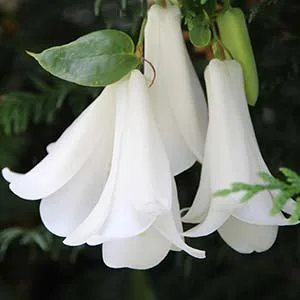
A twining climber, spreading slowly by suckers, with ovate, dark green leaves to 12cm long. From summer to late autumn, slender, fleshy, bell-shaped white flowers to 9cm long are produced
Scientific classification
- Species
- Chilean bellflower (Lapageria rosea var. albiflora)
- Genus
- Lapageria
- Family
- Philesiaceae
- Order
- Liliales
- Class
- Liliopsida
- Phylum
- Magnoliophyta
- Information to be completed
- Toxicity
- Climber Wall Shrub
- Plant type
- 4-8 metres
- Height
- 2.5-4 metres
- Spread
- Evergreen
- Foliage
- Climbing · Suckering
- Habit
- Spring · Summer · Autumn · Winter
- Season of interest
- Full sun · Partial shade
- Sunlight
- Information to be completed
- Ideal temperature









Chilean bellflower pictures
Distribution of Chilean bellflower
Distribution map
- Native
- Introduced
- Cultivated
Source:WCVP v16 · Royal Botanic Gardens, Kew · CC BY 3.0 · Boundaries:WGSRPD / TDWG
Chilean bellflower care guide
- Water regularly, keeping the soil moist but well-drained; reduce in winter.
- Watering
- Full sun · Partial shade
- Sunlight

Watering
Water regularly, keeping the soil moist but well-drained; reduce in winter.
Fertilizing
 Fertilizing
Apply a balanced fertilizer monthly during the growing season.
Pruning
 Pruning
Routine pruning is unnecessary; shorten overlong shoots to fit the available space. For last-year flowering growth, prune after flowering; for current-year flowering growth, prune in late winter or spring. This guidance is for established plants.
Propagation
 Propagation
Propagate by seed that has been soaked in water for 48 hours, at 13-18°C in spring. Take semi-ripe cuttings in late summer, or layer in autumn
Growing
 Growing
Under glass, grow in lime-free (ericaceous) compost with added sharp sand, in bright, filtered light. During the growing season water moderately and apply a balanced liquid fertiliser monthly; water sparingly in winter. Outdoors grow in humus-rich, moist but well-drained, neutral to acid soil in partial shade. Provide support, protection from cold, drying winds, and a dry winter mulch
Common pests and diseases
Diseases
Generally disease-free
Pests
May be susceptible to aphids, scale insects, mealybugs and thrips
Explore the plant health library →




