



Planting and Growing variegated Swiss cheese plant

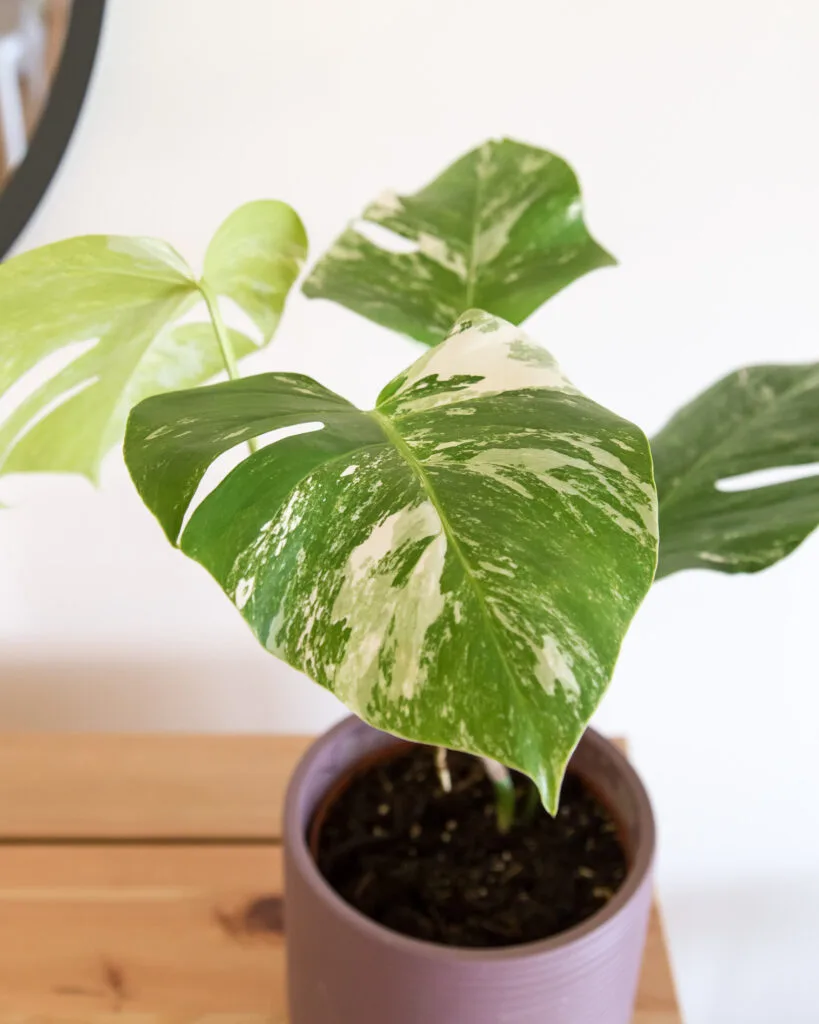
| Care difficulty | 4 / 5 |
|---|---|
| Watering schedule | Moderate regular watering, allowing brief slight drying between soakings |
| Sunlight requirements | Partial shade |
| Ideal temperature | 18 – 27 °C |
| Soil type | Chalk · Clay · Loam · Sand |
| Soil pH | Acid · Alkaline · Neutral |
| Soil moisture | Moist but well drained |
| Fertilizing | Balanced perennial feed every four weeks from spring through summer |
| Toxicity | Harmful if eaten, skin/eye irritant. Wear gloves and other protective equipment when handling] |
How to Water variegated Swiss cheese plant?
Originating from the dense underbrush of tropical rainforests, variegated monstera thrives in high humidity and consistent moisture. This species is well-adapted to the occasional dry spell but prefers a stable water supply. Watering should be done every week to mimic its natural habitat's conditions. As an evergreen plant often grown indoors due to its striking variegated foliage, variegated monstera benefits significantly from regular misting to maintain the ambient humidity it craves.
Learn more →What Are the Sunlight Requirements for variegated Swiss cheese plant?
Variegated monstera thrives best in bright, indirect light, which is crucial for enhancing its unique variegation. While it can tolerate some direct sunlight, prolonged exposure may lead to scorched leaves. It is adaptable to lower light conditions found in partial sun or even full shade, but its growth might slow down, and the vibrancy of its leaf variegation can diminish under such circumstances. Ideally, placing variegated monstera in a location where it can receive filtered sunlight through curtains or blinds is optimal. When grown indoors, a spot near a window with eastern or southern exposure suits it well, ensuring it receives the right amount of light without direct harsh rays.
Learn more →What Is the Ideal Temperature Range for variegated Swiss cheese plant?

Variegated monstera exhibits significant adaptability, tolerating temperatures from 5℃ (41℉) to 43℃ (109℉). It is sensitive to prolonged exposure to temperatures outside this range. Cold snaps may cause leaf discoloration and damage, while overheating can lead to leaf curling and browning. In colder climates, a greenhouse or indoor setting is ideal to prevent freezing. Conversely, in hot environments, shade and increased humidity are essential to mitigate heat stress. Regularly monitoring temperature and providing appropriate protection can ensure variegated monstera's health and vibrant appearance.
Learn more →What Soil Is Best for variegated Swiss cheese plant?
The optimum soil for variegated monstera is well-drained soil, which is slightly acidic with a pH value of 6.1-7.5. While variegated monstera can tolerate slightly sandy soil, it prefers moist loamy soil, which is rich in nutrients. If you have standard potting soil, then add in perlite to improve drainage and avoid root rot.
- Soil type
- Chalk · Clay · Loam · Sand
- Soil pH
- Acid · Alkaline · Neutral
What Are the Moisture Requirements for variegated Swiss cheese plant?
Moist but well drained
Learn more →How to Fertilize variegated Swiss cheese plant?

It is recommended to feed your variegated monstera once a month in summer and spring with a water-soluble fertilizer. In the fall and winter, stop feeding your plant as it will not be in a growing stage. A top tip is to flush the soil after 6 months of feeding to remove any salt build-up, which can affect your plant's health.
Learn more →How to Prune variegated Swiss cheese plant?

Variegated monstera features large, variegated leaves and benefits from early spring pruning. Remove dead or damaged leaves to promote healthy growth. Trim leggy stems to maintain shape and encourage bushiness. Sanitize pruning tools to prevent disease transmission. Pruning helps manage size, enhances light penetration, and revitalizes the plant. Always cut just above a node to foster optimal regrowth. For best results, avoid heavy pruning during active growth phases, focusing on regular maintenance.
Learn more →How to Propagate variegated Swiss cheese plant?

Variegated monstera is a tropical plant valued for its distinctive, ornamental leaves with natural variegation. Propagating variegated monstera involves taking stem cuttings with at least one node and aerial root. Ensure the selected cutting has variegated sections for maintaining the pattern. Cuttings can be rooted in water until roots develop or planted directly in well-draining soil. High humidity and warm temperatures support successful rooting. Rooting hormone is optional but can enhance root growth. Once established, variegated monstera requires indirect light, consistent watering, and periodic fertilization for optimal growth.
Learn more →How to Transplant variegated Swiss cheese plant?
Moving variegated monstera is best during early to late spring or early winter due to favorable temperatures and active growth. Ensure a bright, indirect light location. If necessary, water thoroughly post-transplant to aid acclimation.
Learn more →How to Care for variegated Swiss cheese plant in Winter?

Information to be completed
Learn more →How to Plant variegated Swiss cheese plant?
Plant your variegated monstera in a deep container that is twice the size of the main root ball. The container should have drainage holes to help avoid the variegated monstera developing root rot. Lightly press the soil once planted. It's recommended to repot your variegated monstera every 1-2 years in spring before the growing season, and increase the pot size by around 5 cm across to encourage growth. When Swiss cheese vine (Monstera obliqua) is grown outdoors, it will attach itself to trees to be supported as it grows. When grown as a houseplant, it will need support to assist its growth once it has more than two or three leaves. This support can be through a moss-covered plant pole or bamboo stake.
Learn more →How to Repot variegated Swiss cheese plant?
Information to be completed
Learn more →How to Harvest variegated Swiss cheese plant?

While the variegated monstera can bear fruit from the age of six when growing in its natural habitat, it very rare for a houseplant. The fruit that it produces is known for being sweet and tasty when ripe, but if eaten before it is ripe, it can cause throat and skin irritation due to the oxalic acid it contains. Available to harvest in spring, you will know when the fruit is ripe because the outer skin, made up of green hexagonal scales, will start to fall off. It usually takes a full year for the fruit to ripen.
Learn more →Common Pests & Diseases

Diseases
Generally disease free
Pests
May be susceptible to scale insects and glasshouse red spider mite
Explore the plant health library →The Toxicity of variegated Swiss cheese plant
Harmful if eaten, skin/eye irritant. Wear gloves and other protective equipment when handling]