



Planting and Growing tiger tooth aloe

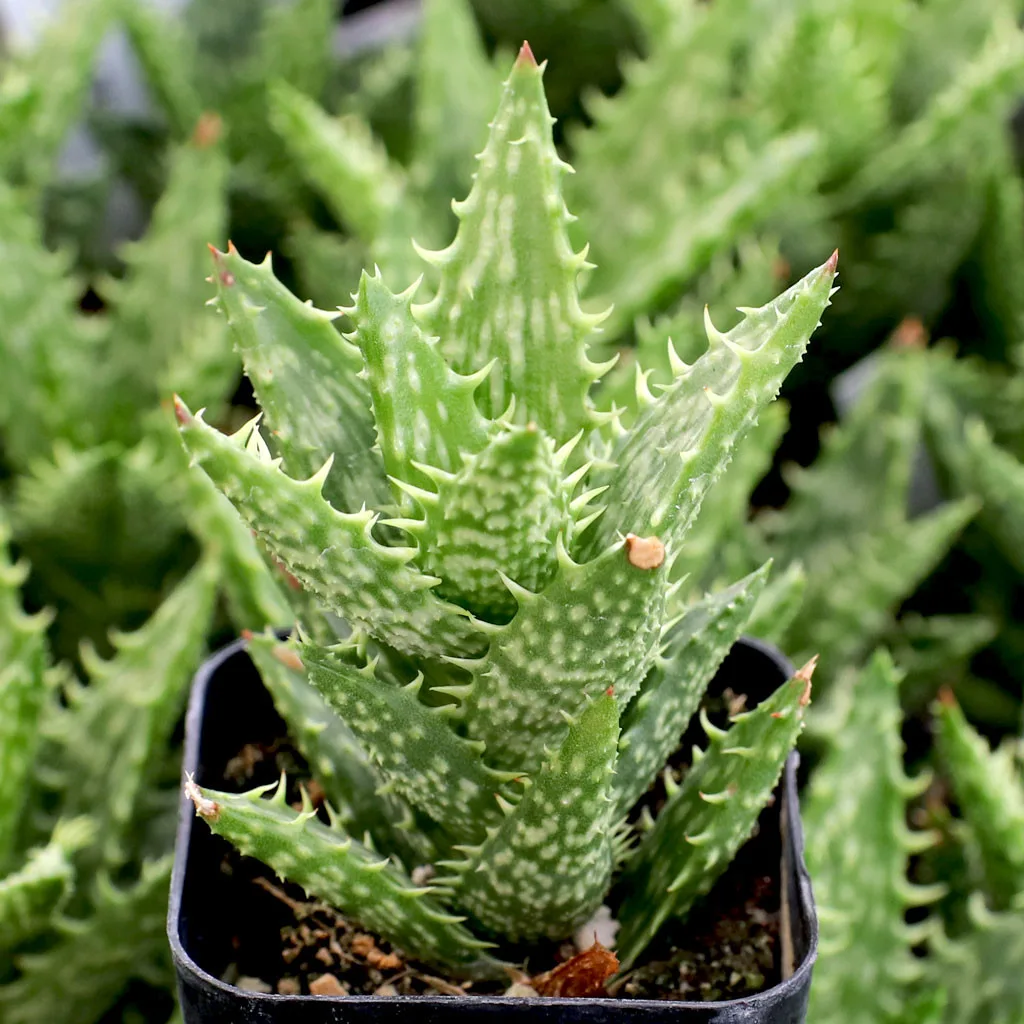
| Care difficulty | 2 / 5 |
|---|---|
| Watering schedule | Let gritty substrate dry completely before giving another full soaking |
| Sunlight requirements | Full sun |
| Ideal temperature | 18 – 28 °C |
| Soil type | Loam · Sand |
| Soil pH | Acid · Alkaline · Neutral |
| Soil moisture | Well drained |
| Fertilizing | Ultra-diluted low-nitrogen succulent feed monthly warm summer only |
| Toxicity | Harmful if eaten. Wear gloves and other protective equipment when handling |
How to Water tiger tooth aloe?
Originating from arid regions, tiger tooth aloe has adapted to thrive with minimal moisture, displaying a strong drought tolerance. Its succulent leaves store water, allowing it to withstand prolonged dry periods. Watering should be sparse, aligning with its desert ancestry—once every three weeks is sufficient. Cultivated primarily as an indoor plant due to its modest size and ornamental appeal, tiger tooth aloe benefits significantly from well-draining soil that mimics its native habitat's conditions.
Learn more →What Are the Sunlight Requirements for tiger tooth aloe?
Tiger tooth aloe thrives best in full sun conditions, where the intensity and quality of light promote optimal growth and enhance its vibrant leaf coloration. While it can tolerate partial sun, prolonged exposure to lower light levels may lead to reduced growth vigor and potential etiolation, where the plant stretches unnaturally due to insufficient light. Ideally placed in outdoor environments, tiger tooth aloe should be positioned in locations that receive several hours of direct sunlight daily. Adaptively, tiger tooth aloe's leaves might exhibit a richer, deeper hue when exposed to bright sunlight, serving as a natural protective mechanism against intense light conditions.
Learn more →What Is the Ideal Temperature Range for tiger tooth aloe?

Tiger tooth aloe shows impressive adaptability to temperature fluctuations, tolerating a range from 0℃ (32℉) to 43℃ (109℉). Despite its resilience, tiger tooth aloe can suffer under extremes. In cold conditions, it may exhibit signs of frost damage, such as blackened or mushy leaves. Conversely, excessive heat can cause sunburn, characterized by browning or scorched foliage. For optimal care, provide protection during peak cold or heat, like covering or relocating the plant. If symptoms of temperature stress appear, adjust the environment immediately and ensure adequate hydration and shading. Such measures ensure tiger tooth aloe's health and robustness.
Learn more →What Soil Is Best for tiger tooth aloe?
Tiger tooth aloe naturally grows in dry and poor soil, but it can thrive in other soil types. The most important condition is that the soil has good drainage, because it is very prone to root rot, especially if grown in soil that retains moisture. Sandy and gravelly soils are the best choices, but commercial potting soils mixed with sand, perlite, or similar substrate in a 1:1 ratio can be used too. Tiger tooth aloe is adapted to withstand slightly acidic, neutral, and slightly alkaline soils (pH 6-9), but it grows best in neutral to slightly alkaline environments (pH 7-8.5). A combination of pasteurized soil, sand, and peat moss in a 1:1:1 ratio can also serve as a good substrate. Use pots with plenty of drainage holes to prevent water retention.
- Soil type
- Loam · Sand
- Soil pH
- Acid · Alkaline · Neutral
What Are the Moisture Requirements for tiger tooth aloe?
Well drained
Learn more →How to Fertilize tiger tooth aloe?

For tiger tooth aloe, use a balanced fertilizer designed for succulents and cacti during spring and summer, its active growth period. Quarterly application is optimal, and it's crucial to dilute the fertilizer to half-strength to avoid root burn. Benefits include promoting robust growth and possibly enhancing blooming. Over-fertilizing can lead to leggy growth, so adhere to less-is-more. During dormancy in fall and winter, cease fertilization to prevent harm to tiger tooth aloe's natural growth cycle.
Learn more →How to Prune tiger tooth aloe?

Tiger tooth aloe does not require pruning in the general sense; you need only remove spent flower stalks or dead leaves. Leaves that have turned orange or brown should be trimmed to deliver more nutrients to green plant parts, keeping the plant healthy. Smaller and medium-sized plants can be pruned with a knife, while larger plants require pruning shears. Remove any spent flower stalks or plant material, as well as parts of leaves that have changed their color or started drying.
Learn more →How to Propagate tiger tooth aloe?

A rejuvenating succulent, tiger tooth aloe, excels through division, which involves separating the offsets that naturally emerge at its base. Carefully remove these offshoots, ensuring they include roots, and then allow the cut area to callous for a couple of days to prevent rot. Once prepared, plant the offsets in a well-draining soil mix tailored for succulents. Provide them with bright, indirect light and water sparingly to encourage new growth. Patience is key; establish a steady growth environment, and tiger tooth aloe will thrive.
Learn more →How to Transplant tiger tooth aloe?
Best transplanted in the warming embrace of spring, tiger tooth aloe thrives when introduced to well-draining soil in a sunny locale. Ensure gentle handling to prevent root damage. A welcoming environment promotes robust growth.
Learn more →How to Plant tiger tooth aloe?
Indoors-potted: Keep your potted tiger tooth aloe near a window where it can bask in the glow of your home, enriching spaces with its striking toothy edges. Outdoors-potted: Tiger tooth aloe thrives outdoors in pots; rotate them periodically for uniform growth, showcasing their sculptural beauty to visitors. Outdoors-in the ground: In-ground tiger tooth aloe prefers a spot that mirrors its natural arid habitat, ensuring robust growth and an impressive spiky display.
Learn more →How to Repot tiger tooth aloe?
Repot tiger tooth aloe once biennially to accommodate its growth, ideally during spring. As a compact succulent, tiger tooth aloe doesn't require a large container, yet it's vital to upgrade to a pot 1-2 inches wider to encourage healthy development. Post-repotting, ensure tiger tooth aloe is in well-draining soil and offer bright, indirect light for recuperation. Avoid overwatering, allowing tiger tooth aloe to thrive with minimal, attentive care.
Learn more →Common Pests & Diseases

Diseases
Generally disease-free
Pests
May be susceptible to scale insects and mealybugs
Explore the plant health library →Troubleshooting
Crown Rot, Soft Brown Base, or Mushy Leaves
tiger tooth aloe (Aloe juvenna) is a compact South/East African rosette succulent that rots easily if water collects inside leaf bases or if potting soil stays wet.
| What you notice | Possible explanation | What to check next |
|---|---|---|
| Inner rosette leaves turn brown-black and mushy at the base and pull loose easily | Crown or root rot caused by overwatering, dense soil, or water trapped in the rosette center | Check soil moisture and gently test whether center leaves are firmly attached |
| Leaf tips turn brown and curl inward while leaves feel thin and concave | Underwatering or excessive direct afternoon sun | Check potting mix dryness and evaluate sun exposure |
| Oldest bottom leaves dry out slowly while the central rosette stays plump and green | Normal lower leaf aging as the rosette grows | Verify that central leaves and offshoots are firm |
- Grow in a gritty, fast-draining cactus/succulent compost with extra horticultural grit or perlite in a pot with drainage holes.
- Water thoroughly only after the soil has dried completely, pouring water onto the soil rather than into the rosette crown, and keep very dry in winter.
- Provide bright, filtered light or gentle morning sun, shading from scorching midday summer sun.
Stop watering immediately and discard rotted crowns; salvage any firm, unaffected basal offsets (pups) by letting cut ends callus for a day before potting.
Stretched Pale Rosettes or Mealybugs in Leaf Axils
Low indoor light causes compact rosettes to stretch and lose white banding/spots, while mealybugs hide deep in leaf axils.
| What you notice | Possible explanation | What to check next |
|---|---|---|
| Rosette opens flat and stretches upward with pale green leaves | Insufficient bright light | Evaluate daily light intensity at the growing spot |
| White cottony insects or sticky residue tucked inside leaf axils | Mealybug or scale infestation | Inspect tight overlapping leaf bases closely with a bright light |
- Move to a brighter windowsill with strong indirect light or morning sun.
- Isolate pest-affected plants and dab visible mealybugs with a cotton swab dipped in rubbing alcohol.
- Separate crowded offsets in spring or early summer to improve airflow around the mother rosette.
Keep tiger tooth aloe (Aloe juvenna) away from pets, as ingestion can cause digestive upset.
The Toxicity of tiger tooth aloe
Harmful if eaten. Wear gloves and other protective equipment when handling