
Daylily
Also known as: Daylily, Common daylily
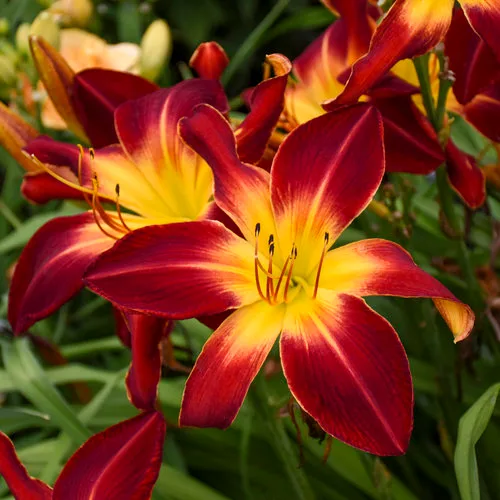
Hemerocallis hybrid is a clump-forming herbaceous perennial with a dense mound of arching, strap-shaped green leaves. In summer, tall flower stems (scapes) bear numerous trumpet-shaped blooms in a wide range of colors including yellow, orange, red, pink, and purple. Each flower lasts only one day, but a single plant produces successive blooms over several weeks, creating a continuous display. Its robust growth and vibrant flowers make it a popular choice for borders and naturalistic plantings.
Scientific classification
- Species
- Daylily (Hemerocallis hybrid)
- Genus
- Information to be completed
- Family
- Asphodelaceae
- Toxic to cats if ingested (can cause kidney failure). Mildly toxic to humans if raw flowers or roots are consumed in large quantities. Cooked flowers (daylily buds) are edible and safe.
- Toxicity
- Herbaceous Perennial
- Plant type
- 0.5 - 1.2 metres
- Height
- 0.3 - 0.6 metres
- Spread
- Deciduous
- Foliage
- Clump forming
- Habit
- Summer
- Season of interest
- Full sun
- Sunlight
- 15 – 25 °C
- Ideal temperature









Daylily pictures
Distribution of Daylily
Distribution map
Eastern Asia (China, Japan, Korea, Russia)
Toxicity
Toxic to cats if ingested (can cause kidney failure). Mildly toxic to humans if raw flowers or roots are consumed in large quantities. Cooked flowers (daylily buds) are edible and safe.
Daylily care guide
- Keep soil moist during active growth, especially in summer
- Watering
- Full sun
- Sunlight
- 15 – 25 °C
- Ideal temperature

Watering
Keep soil moist during active growth, especially in summer
Fertilizing
 Fertilizing
Apply a balanced fertilizer in early spring and again after flowering
Pruning
 Pruning
Remove spent flower stalks after flowering to encourage rebloom and maintain a neat shape. Cut back old foliage in late autumn or early spring.
Propagation
 Propagation
Divide established clumps in early spring (March-April) or autumn (September-October). Lift the clump, separate into sections each with several fans of leaves and roots, and replant at the same depth. Water well after division. Seeds can be sown in spring but offspring may not come true.
Growing
 Growing
Grow in fertile, well-drained soil in full sun for best flowering, though it tolerates light shade. Water regularly during dry spells to keep the soil moist but not waterlogged. Apply a balanced slow-release fertilizer in early spring and again after the main flowering period. Deadhead spent blooms and remove flower stalks after flowering to maintain a tidy appearance. Mulch in autumn to protect the crown in colder regions. Divide clumps every 3-5 years in early spring or autumn to maintain vigor.
Common pests and diseases
Diseases
Generally disease-resistant, but may suffer from rust, leaf spot, and crown rot in poorly drained soil. Good air circulation and proper watering help prevent issues.
Pests
Susceptible to aphids, spider mites, thrips, and slugs. Regular inspection and organic controls such as neem oil are effective.
Explore the plant health library →




