



Planting and Growing desert cabbage

| Care difficulty | 2 / 5 |
|---|---|
| Watering schedule | Water deeply when soil is dry, reduce in winter |
| Sunlight requirements | Full sun |
| Ideal temperature | 18 – 28 °C |
| Soil type | Loam · Sand |
| Soil pH | Acid · Alkaline · Neutral |
| Soil moisture | Well drained |
| Fertilizing | Monthly during growing season |
| Toxicity | Information to be completed |
How to Water desert cabbage?
Paddle Plant is a plant that thrives in arid conditions, showing a high level of drought tolerance. It has adapted to conserve water, reflecting its origins in dry habitats. This species requires watering once every three weeks, maintaining a balance without over-saturating the soil. As an evergreen plant often grown outdoors, paddle Plant can retain its water content even under intense sunlight, demonstrating its resilience and adaptability.
Learn more →What Are the Sunlight Requirements for desert cabbage?
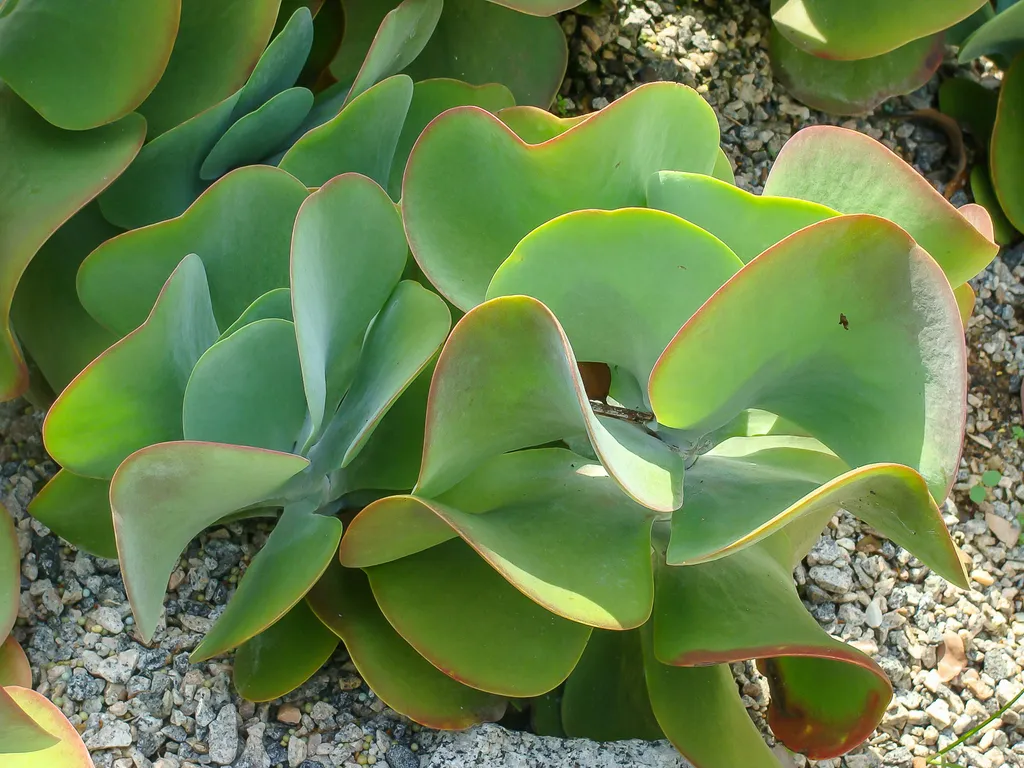
Paddle Plant thrives in full sunlight, which enhances its growth and contributes to the vibrant coloring of its paddle-shaped leaves. It can tolerate partial sun, but prolonged exposure to lower light levels may result in leggy growth and diminished leaf coloration. To optimize health, it's advisable to position paddle Plant in locations where it can receive at least six hours of direct sunlight daily. Outdoors, a south-facing garden is ideal. This light exposure encourages a rich, red hue on the leaves, a sign of good health and robust photosynthesis in paddle Plant.
Learn more →What Is the Ideal Temperature Range for desert cabbage?

The suitable growth temperature of paddle Plant is above 15 ℃, and it can grow normally in spring, summer and autumn. It can tolerate high temperature, but it will enter the dormancy period when the temperature is higher than 33 ℃ (Sedum lineare is a special species that still grows well under high temperature in summer.). When the temperature is lower than 5 ℃ in winter, it is recommended to move paddle Plant indoor to avoid irreversible frostbite or even death. If you are in a cold region, it is not recommended to plant it directly in the garden, but as a potted plant. When it enters its dormancy, it needs less watering; during its growing season, a small amount of water is needed.
Learn more →What Soil Is Best for desert cabbage?
Paddle Plant requires well-aerated, well-draining soil to prevent water-logging. A suitable soil mix can be made by combining two parts cactus or succulent soil with one part perlite. Ensure good drainage by using a pot with drainage holes. Optionally, add a slow-release, balanced fertilizer in spring and summer to encourage growth. If perlite is not available, coarse sand can be used as an alternative for better drainage.
- Soil type
- Loam · Sand
- Soil pH
- Acid · Alkaline · Neutral
What Are the Moisture Requirements for desert cabbage?
Well drained
Learn more →How to Fertilize desert cabbage?

For paddle Plant, use a balanced, water-soluble succulents and cacti food at a quarter strength during active growth in spring and summer. Fertilize monthly, ensuring soil is damp to avoid root burn. This boosts paddle Plant's growth, flowering potential, and vitality. In fall and winter, halve the frequency as paddle Plant enters dormancy. Use caution to avoid over-fertilization, which leads to leggy growth and weakens paddle Plant. Reduce doses for young or recently repotted paddle Plants, catering to their delicate nutrient needs.
Learn more →How to Prune desert cabbage?

In order to keep beautiful shape, some large succulent plants may need pruning. For example, in California, for echeveria planted in the garden, some redundant branches and branches that are too dense need to be cut off in spring and autumn. This depends on what you think and what the succulent plant is used for. Tools for pruning mainly include knife, scissors, and some medicines (such as sulfur powder). In order to propagate new plants, we can also cut some leaves in spring and autumn for cutting. Stout stems with 5-6 leaves are often selected: cut it off with a knife, then smear the wound with sulfur powder, and plant it after the wound is healed. At this time, it is recommended to use a watering can to slightly wet the soil used for cutting.
Learn more →How to Propagate desert cabbage?

Paddle Plant is a succulent known for its distinctively shaped leaves resembling paddles. It thrives in well-draining soil and requires adequate sunlight to maintain its vibrant coloration. Propagation for paddle Plant is effectively achieved through cuttings. Gardeners should select healthy leaves, allow them to callous over for a few days, and then gently press them into a suitable growing medium. Rooting hormone can enhance success, but isn't mandatory. Consistent but moderate watering after planting encourages growth without risking rot. With patience and proper care, new shoots will form at the base of the leaves, signaling successful propagation.
Learn more →How to Transplant desert cabbage?
The perfect time to transplant paddle Plant is when the warmth of late spring caresses the soil, making it an opportune moment for root establishment. Choose a sunny spot with excellent drainage and enrich the move with a touch of organic compost if needed, to welcome paddle Plant into its new home.
Learn more →How to Plant desert cabbage?
When planting, you can first add the soil of the lower hydrophobic layer to the flowerpot, and then add a small amount of soil of the planting layer. Then spread out the root system of the plant and put them in. Cover the plant root with planting soil slowly, then add the top deco soil, and finally pour water once. If it is planted in the garden, you need to dig a pit 1.5-2 times the size of the root system first, and then follow the above steps. In order to make it grow better and faster, or if the roots are too dense or unhealthy, it needs to be repotted. It is recommended to repot in spring and autumn. Before repotting, stop watering a few days in advance, after the soil is dried, you can gently knock the pot outside. Or you can use a knife to separate the soil from the pot. When pulling the plant up slightly, you can easily take out the plant, and then follow the steps described in the previous paragraph. It should be noted that, though you can plant different colors of succulent plants together, it is better to avoid planting succulent plants with different growth habits together. Some succulent plant growing in summer needs water, while other succulent plant in dormancy period does not need water. If they are planted together, the succulent plant in dormancy period will become sick due to excessive watering, while the succulent in growing period will wither due to insufficient water.
Learn more →How to Repot desert cabbage?
For the vibrant, rosette-forming paddle Plant, repot in spring every 2 years to accommodate its growth. Use a pot slightly larger than its current one for best results. Post-repotting, place paddle Plant in bright, indirect light and resume watering after a week to prevent root rot, ensuring a rapid and healthy recovery.
Learn more →Common Pests & Diseases

Diseases
May be susceptible to leaf spot
Pests
May be susceptible to mealybugs and aphids
Explore the plant health library →Troubleshooting
Mushy Translucent Leaves, Leaf Drop, or Basal Stem Rot
desert cabbage (Kalanchoe luciae) stores water in fleshy leaves and rots rapidly when kept wet in dense soil or cool weather. In Kalanchoe luciae, the central rosette elongates into a tall flower spike and naturally dies back after blooming while producing basal offsets.
| What you notice | Possible explanation | What to check next |
|---|---|---|
| Lower leaves turn translucent, yellow, and mushy, or drop at a light touch while soil is damp | Overwatering, poorly drained potting mix, or water trapped in leaf rosettes | Check whether the potting mix stays wet and inspect the stem base for blackening |
| Leaves look wrinkled, deflated, and thin while the gritty mix is completely dry | Underwatering during warm active growth | Feel deep into the pot and lift it to confirm total dryness |
| Tall central flower stalk forms followed by gradual yellowing of the main rosette while small pups grow at the base | Normal monocarpic post-bloom senescence in Kalanchoe luciae | Inspect the base for healthy green offsets |
- Pot in a sharply drained mineral-rich succulent mix (cactus compost amended with coarse grit, perlite, or pumice) in a pot with drainage holes.
- Water thoroughly only after the entire potting mix has dried out completely, and keep much drier during cool winter rest.
- Water at the soil line rather than pouring water into leaf rosettes or onto fuzzy foliage.
- If basal rot occurs, cut above the blackened stem with a sterile blade, let the cutting callus for several days, and root in dry-to-barely-damp gritty mix.
Stop watering immediately if the stem base turns black and soft; decayed roots cannot recover.
Keep desert cabbage (Kalanchoe luciae) out of reach of pets and children, as ingestion can cause toxicity.
Stretched Etiolated Growth, Faded Color, or Mealybugs
Insufficient direct sunlight causes stems to stretch and lose compact form or red leaf margins, while mealybugs hide in tight leaf axils.
| What you notice | Possible explanation | What to check next |
|---|---|---|
| Wide gaps between leaves, pale green color, and leaning or floppy stems | Insufficient bright light (etiolation) | Assess daily hours of direct sun or bright windowsill light |
| White cottony tufts in leaf axils or sticky residue on stems | Mealybug or scale infestation | Inspect tight leaf bases, stem junctions, and pot rims closely |
- Move gradually into brighter light (such as a sunny south- or west-facing windowsill) so leaves regain compact growth and natural red-tinted margins without sudden sunburn.
- Prune stretched stems in spring, allow cut ends to callus for a few days, and root cuttings in gritty succulent mix.
- Isolate pest-infested plants and dab visible mealybugs with a cotton swab dipped in rubbing alcohol.
Acclimate shade-grown succulents to intense summer sun gradually over one to two weeks to prevent bleached sunburn scars.